Showing posts with label Lake Magazine. Show all posts

Tuesday, December 19, 2006

Suburban Man: The Fish Police


By Rick Kaempfer


I’ve always believed that every child should have a pet. It teaches responsibility, the circle of life, and gives the children something they can love unconditionally. Unfortunately, my kids are deathly allergic to animals that have hair or fur. That ruled out the traditional array of dogs, cats, hamsters, guinea pigs, mice, rats, ferrets, or farm animals, and left us with only two reasonable choices; reptiles or fish. Since my wife is part of the decision making process, it left us with only one choice. We got the fish. It was our Christmas present to our two oldest boys, who were 4 and 1 ½ at the time.

From the moment I stepped into the fish store I knew that I was getting into something much more intense than I ever imagined. It was like a college entrance exam. First I had to bring the fish guy water samples to make sure that our tank had the proper PH balance. The first three times I didn’t pass the test and he wouldn’t allow me to purchase the fish. I finally passed his rigorous testing on the fourth try, but when I said I wanted to put some decorative plastic plants in the tank with the fish, he gave me a whole new list of instructions before I would be allowed to bring home the fish.

Each time I went into the store, I held my breath that the fish guy would allow me to spend $2 in his store to buy a few fish. It was two days before Christmas when I was finally, and grudgingly deemed “fish worthy.” But before he handed me the baggies filled with fish and water, he looked me in the eye and gave me a stern look.

“Are you going to take care of these fish?” he asked.

“Yeah sure,” I said, praying I wasn’t saying anything to disturb the fish police.

“How do you put them in the tank?” he quizzed.

“I put the whole baggy in the tank, let them adjust to the water, and…..” I was choking under pressure. I couldn’t remember exactly what to do. The fish guy walked out from behind the checkout counter, toward the back of the store, in the direction of the former fish tank home of my fish. He was apologetic, but uncompromising.

“Look, I’m sorry, but you aren’t ready…”

“Wait!” I said. “You get a little bit of water out of your tank, mix it with the water in these baggies, and slowly let them get used to the water.”

“And then how do you put them in the tank?” he asked. He was now holding them over their old tanks, ready to put them back into the water. He looked like he was cursing himself for letting his guard down around such an obviously un-fish-worthy person like me. What was he thinking trusting me with $2 of fish?

“You grab them out with the net?” I answered hopefully.

“Are you sure about that?” he asked. He was shaking his head doubtfully. It looked like he was memorizing my face for the sketch artist and mentally designing a “DO NOT SELL FISH TO THIS MAN” flier to distribute to all the fish stores in the Midwest.

“Yes,” I answered, this time more confidently.

“Would you willing to bet these fish on that?” he asked.

“I would never bet on the lives of fish,” I said. “They are precious to me.”

That’s when I broke him. I even thought I saw an Elvis lip snarl—not really a smile, but as close to one as the fish guy ever got. He motioned for me to follow him back up to the register, hopped back around to the other side of the counter, and began to ring up the $2 sale.

“Thank you, sir,” I said as respectfully as possible. “I love fish so much. I just had to spread the joy of fish to my kids.”

That stopped his fingers on the cash register in mid purchase. His right eyebrow cocked suspiciously. “Kids?”

“Um…”

“How old are your kids?” he asked.

“Well they’re grown up now,” I lied.

“How old are you?” he asked, doing the math in his head.

“They’re kids from my wife’s first marriage,” I said, continuing to lie. “28 and 26. Good kids, really. Marine biologists.”

That last lie was a little over the top, but it finally sealed the deal. I was permitted to leave with three little baggies, filled with three little fish, worth less than three little dollars. But the fish guy had gotten into my head. On the ride home I was nervous that the fish police were following me. I was sure they were going to set up some sort of a sting to catch me in the act of endangering the lives of these fish. When I finally arrived home with my precious new family members in my hand, I carried them into the house as if the baggies were filled with nitroglycerine.

My wife tried to hug me when I walked through the door. “Step back!” I urged. “These baggies are filled with fish.”

My dealings with the fish guy had totally altered my plan to unveil the fish on Christmas morning. That would have required a tarp of some kind to cover the tank; something that I’m sure that would have set off the fish guy’s fish alarms. I knew one thing for certain. These fish were fragile creatures that could die at the drop of a hat. I had no choice but to carefully introduce them to their new aquarium and then immediately show the boys their new pets while they were still alive.

I was rehearsing my fish care speech when Tommy (age 4) and Johnny (age 1 1/2) entered the room. Both of their eyes lit up. Tommy smushed his face against the glass, and marveled at the bright colors of the rocks on the aquarium floor. Johnny, on the other hand, reached his hand into the tank and tried to catch the terrified fish as they set 20-gallon-tank speed records to avoid him. He cackled with glee as his splashing left hand produced a giant puddle on the hardwood floor. It happened so fast I was unable to stop him.

“NO!” I screamed.

Johnny didn’t stop splashing. He was having too much fun.

“You’re going to kill the fish!” I said.

Tommy was horrified. “Johnny,” he said, grabbing his brother’s hand out of the tank. “You’re killing the fish.”

It stopped the potential fish-icide just in time. I took a deep breath, but I knew that I was never going to stop him every time. Johnny was an unstoppable force. I couldn’t be there every second; the next time or the time after that. I figured the fish police were going to start their surveillance very soon, and it was only a matter of time before I was hauled off to fish court. At first I tried to avoid the inevitable, but any little let down was taken advantage of by Johnny.

The fish police probably still show the surveillance video of the time Johnny put all fifty of his metal Hot Wheel cars into the tank. They probably had fish paramedics standing by ready to knock down our door the time Johnny used my dirty coffee cup to scoop one of the fish out of the tank. I’m sure their records show that we rarely clean the tank and that we once went on a two week vacation and forgot to have someone come in to feed them. But they can’t press charges against us. We have a perfect alibi.

Those damn fish are still alive. And they’re five years old now.

I think they must be made out of the same material they use for the black boxes in airplane cockpits. I’m pretty sure that if my house burned down, those fish would still be alive, swimming in the water from the fireman’s hose. If Johnny and his little brother Sean (now age 2) didn’t kill them with their various different fish taunting schemes by now, they can’t be killed. They are superhero fish.

I feel a little bit more relaxed these days, but every now and then when I go out to get the newspaper in the morning, I think I see a van from the fish store at the corner. And while I’ve never had the courage to step foot into the fish store again, I’m sure a poster of my face is still hanging behind the cash register, with the snarling headline “THIS MAN IS CRUEL TO FISH.”

I haven’t seen the fish guy now in five years, but if I did, there is something I’d want to say to him: You really should charge a little more than $2 for three fish.

What is the price of immortality?


This article was written as a Suburban Man, but also appeared in Lake Magazine.

Tuesday, August 08, 2006

Suburban Man: Big Toys


By Rick Kaempfer


I have three young sons and lots of relatives, which means that our home has been “collecting” toys five times a year: three birthdays (March, September & October), Christmas, and Easter.

The general collection of our toys, while prodigious, is still not necessarily worthy of mention. Believe me, I’ve seen homes that have double and triple the number of toys we have. It’s a very specific type of toy we’ve accumulated that inspired this column: Little Tikes.

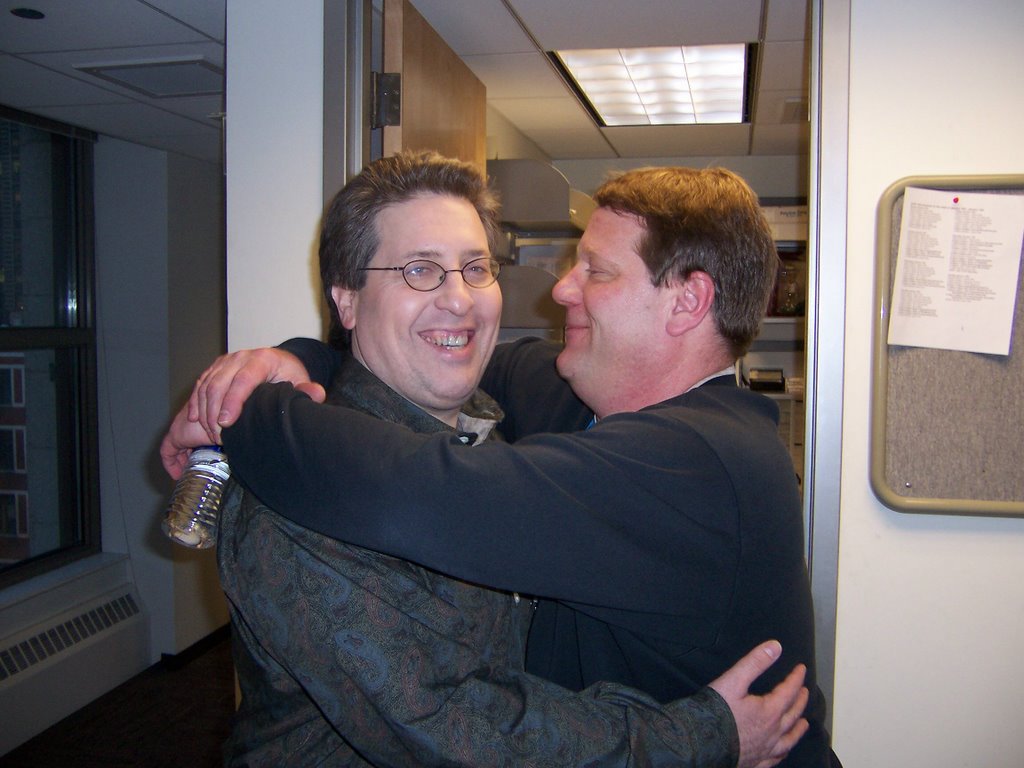
Little Tikes isn’t the only manufacturer of this specific type of toy (pictured above), but they're the industry leader. We started getting Little Tikes toys when my oldest son was a toddler. That was nine years ago, and every year our relatives gave us more.

It happened slowly and stealthily, but one day we suddenly noticed that we had accumulated a huge collection. How huge? Let’s just say that “Little Tikes” is the most ironically named company in the world.

They make GIGANTIC toys: Adult-size toys for tiny children. Tool benches the size of actual tool benches, cars the size of real cars, and play houses the size of three bedroom homes. We’re lucky we have boys. The castles they make for princesses are even bigger. My friend has Buckingham Palace in his backyard.

And while many parents complain that these gigantic toys are too big, we have a completely different take on it at our house. This HUGE collection has actually been a financial boon to our family. Not because it’s valuable, mind you, but because of the incredible incentive it provides us to save money. We have no choice. If we get one more of these toys, we’ll have to move into a bigger home.

I’ve been reading the stories in the news over the past few years about teardowns and bigger homes. Experts have attributed this nationwide trend on many things, but nobody has caught on to the real reason. It’s not a matter of keeping up with the Jones’. It’s a matter of keeping up with the HUGE toy collection. Ordinary single-family homes built in the 40s, 50s, and 60s, can’t sustain even a “little” collection of Little Tikes.

We have a modest suburban three bedroom home. Our basement is completely full, thanks to two or three Little Tikes toys. Two boys share a completely full room, thanks to one Little Tikes toy. The other boy has two Little Tikes toys in his room. The 2 ½ garage is stuffed to the rafters thanks to five or six Little Tikes toys. The backyard is a Little Tikes graveyard.

I know what you’re thinking: sell them at a garage sale. While that sounds good in theory, it won’t work in our neighborhood because everyone else has the same toys stuffed into the same size homes. We could give them away to needy children, but their homes are probably even smaller than ours. We could give them away to rich children with big homes, but my guess is that they aren’t having a difficult time filling their homes either.

So, instead of dwelling on the negative, I'd like to thank Little Tikes.

Thanks to the incentive your gigantic toys have provided us, we have saved more money the past few years than we ever could have imagined. Within ten years or so, we’ll be able to afford that bigger house.

The boys can visit us there when they come home from college.


This was originally written last summer as a Suburban Man, but it also appeared in Lake Magazine.


To see previous Suburban Man Columns, click here: http://suburbanmanarchive.blogspot.com

Sunday, July 02, 2006

Lake Magazine Article: The Demon of Sports Talk

In 2004, I spent an afternoon sitting in on the afternoon sports talk show on ESPN Radio in Chicago--"Mac, Jurko & Harry." At the time, there was an obvious tension in the air. That tension reared it's head again last week, when Dan McNeil (Mac) and Harry Teinowitz got into an on-air fight--causing them both to be suspended for two weeks.
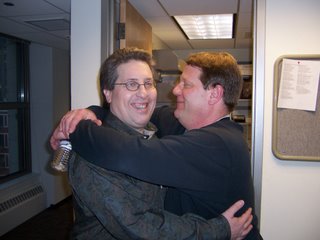


They posed for this picture just for the article, but Lake Magazine decided not to run it. That's Harry on the left, and Mac looking longingly into his eyes.


Read the quotes in the section about the three man booth, and you won't be surprised the tension came out on the air again.


The Demon of Sports Talk

By Rick Kaempfer

(From the Summer 2004 issue of Lake Magazine)


Dan McNeil doesn’t seem to have a filter that stops his thoughts from traveling directly from his brain to his mouth. It’s a trait that has been a double edged sword for the popular afternoon talk radio host on ESPN Radio (AM 1000) in Chicago. It has garnered him a loyal following of listeners who know he will give it to them straight. But it has also garnered him a series of public feuds with bosses and co-workers, and those have led to several suspensions.

Does he ever consider getting a filter installed?

“I try to filter,” said McNeil with a smile. “If what I’m going to say is going to hurt someone close to me, I try to, but I’ve not always succeeded. Whether it’s a family member who is out of line at a 4th of July barbeque that I light up the next Monday, or a friend who doesn’t bring contributions to the Sunday football fest at my home, I’ve said things that have hurt feelings. Most of the people in my universe understand that goes with the territory.”

It’s easier for friends, relatives and co-workers to forgive McNeil than you might imagine. They get over it pretty quickly because they know the harshest slings and arrows have a tendency to wind up in the rear end of the host himself. He has been candid about himself to a fault; particularly about his faults.

“I have given out a lot of things about myself,” he admitted. “I’ve admitted I abused substances. I’ve admitted that my marriage hasn’t worked. All is fair game on the show; if it’s interesting and what’s coming out of the radio in people’s cars is engaging, that’s what I’m looking for. And if it comes at my expense, the expense of my mental health sometimes, that’s the way it goes. A buddy of mine is on me constantly about giving up too much personal stuff, especially the demons. You know what? My attitude is simple. While I don’t talk publicly very much about my spiritual convictions, I believe my higher power has seen everything I’ve done, so what do I care what Mike in Schaumburg thinks?”

Back home again in Indiana

Most of the things his higher power has witnessed have taken place in Highland, Indiana; McNeil’s long-time home town. He grew up in Highland, attended high school there, and remains a resident to this day. The “tell it like it is” approach of the neighborhood is not the only thing that has rubbed off on McNeil.

“My dad was a production supervisor in Hammond,” McNeil said, “he worked his ass off—shift work. Most people in Northwest Indiana have a very strong work ethic. I saw Dad, even though it wasn’t in a white collar environment; commit himself to supporting his family. That’s the part of Indiana I bring with me to work every single day.”

“He puts a lot of time and effort into what he does,” agreed ESPN afternoon co-host John Jurkovic, another Indiana resident. “He has a great passion for his job. He’s got an intensity in the sports radio business that I don’t think a lot of people can match.”

Dan is a combustible potion of intensity, work ethic, and candor mixed together with a passion for sports. That potion has been Danny McNeil since his early days in Indiana.

“When I was eight,” he said, “Kenny Holtzman pitched his first no-hitter for the Cubs against the Braves. I was home sick with an abscess tooth that had been removed. I scored the game, then dragged my mom’s Smith Corona out of the closet and typed a one page story on his no hitter. I was a geek. I would turn the sound down and do play by play of Hawks games. I had this little portable cassette recorder. I remember recording WLS Music Radio’s Top 89 hits of the year on New Years Eve. I was fooling around with audio and writing and broadcasting even though it wasn’t to an audience…just into a recorder.”

He might have been a radio geek behind closed doors, but his love of sports wasn’t limited to watching and broadcasting from the sidelines. McNeil was the captain of the Highland High School football team as a senior, taking the team to its first conference championship in school history (1979). He tried to pursue that love of football at the next level, but that’s where his dream ended.

“I originally went to a Junior College because I thought I was going to play football. I realized after getting the crap kicked out of me every Saturday that I wasn’t going to make money at it. I was attempting to get a ride at Ball State…and I eventually did go to there, but it wasn’t to play football.”

He pursued his other dream instead. The dream that began with the Smith Corona typewriter and the cassette recorder blossomed at the communications college at Ball State. Ball State may not have offered Dan McNeil a chance to play football, but it did give him his first shot at hosting a radio show.

“It was 1981. I got a show on WBST-FM in Muncie playing the Ramones in the middle of the night. It was like the movie Private Parts. ‘If you like music, here’s Deep Purple.’ I was awful.”

But he got the bug. And although he got an offer to do radio in Fresno, the money and the location weren’t right. He just couldn’t see himself in California. The Indiana boy stayed close to home, and accepted the job as the Radio/TV writer at the Hammond Times newspaper. In what would become a habit at every stop in his illustrious career, McNeil let it be known what he wanted.

“They threw me a bone to cover sports because they knew I was going to miss it,” is the way McNeil explained it. “And covering sports led me to Chet Coppock. He was a pretty good self promoter in those days, and we developed a relationship. When Chet moved from WMAQ radio to the Loop (AM 1000) in 1988, his producer overplayed her hand. She wanted more money than the station was willing to offer her, so it quickly happened between Chet and me. I became his executive producer.”

The Big Bohunk

Chet Coppock was one of the pioneers of sports radio in Chicago. After overplaying his own hand at WMAQ television, he eventually landed at WLUP-AM, hosting the night time sports talk show after Steve Dahl & Garry Meier.

Producing a show after that famous twosome was more of a timing challenge than McNeil imagined it would be. Steve & Garry’s show was supposed to end at 7pm, but routinely ended at 7:05, or 7:10, or 7:15 or whenever Steve felt like ending it. McNeil and Coppock always tried to book the biggest sports stars at the beginning of their show to take advantage of the formidable lead-in audience, but when big-name guests had to hold on the phone for fifteen minutes, (or worse, couldn’t hold on for fifteen minutes) McNeil’s passion would get the best of him. The studio wall at the old Loop studios had the perfect imprint of Dan McNeil’s fist before construction on the new studios began.

But working as the Executive Producer for Chet Coppock was also the big break for Dan McNeil’s radio career. Somehow, the jive insincerity of Chet worked well with the Indiana candor of McNeil. At least it did at first.

“Yeah, it worked pretty well the first couple of years,” McNeil said. “And I recognize the effect he had on my ascendancy in Chicago sports radio. Without him I probably wouldn’t be here talking to you today about what I do.”

But the marriage ended badly. McNeil began filling in for Chet when he was on vacation, and began to feel the itch to spread his wings. “I sucked on the air filling in for him,” McNeil says. “I was terrible.”

But the programming staff putting together Chicago’s first all-sports radio station, WSCR Radio, didn’t think so. They made a pitch to Chet Coppock, and he flatly refused to move to the rinky-dink daytime-only station (820 AM at the time). After being rebuffed by Coppock, the Score went after his Executive Producer. McNeil jumped at the chance, and his relationship with Coppock, which had begun to sour, was irretrievably damaged. The two men bickered in print and on the air against each other for more than a decade, but McNeil says that they have recently mended fences.

“I ran into Chet at US Cellular last year,” McNeil said. “He and his son were sitting in front of me at the ballpark. And when his son Tyler told me he was a White Sox fan and hated the Cubs, I immediately went and bought him an ice cream sandwich. Chet, of course, took a pass—probably still on Nutrisystem. But we’ve had a few telephone conversations since then. I feel good about where he and I are at. He was a tremendous influence on my career, and for that I will always be thankful. The stuff that happened afterwards was ugly on both sides, and I don’t want to dredge that up again. With age comes maturity.”

The Score

With maturity came his voice. He remembers distinctly when that moment occurred; it was midway through his nine year run at WSCR.

“I was terrible for my first couple of years at the Score. I didn’t feel comfortable doing it until 1996. I was in Seattle with the Bulls in ’96, and had put together a string of shows that was pretty good—and did things socially with people I really respected on a national level like Mike Tirico and Dan Patrick. We were out howling at the moon one night, they came on the show the next day, and I felt the wind break. For the first time I knew I made the right decision. It was a specific occurrence. But it was a long time after I started there.”

It was a bumpy road at the Score. The frequency at 820AM was only licensed for day-time broadcasting, so WSCR wasn’t taken seriously by the rest of the media at first. They eventually moved their frequency twice in the next few years. First to 1160AM when Infinity Broadcasting blew up the format of WJJD, and then to 670AM when Infinity Broadcasting blew up the format at WMAQ. The on-air lineup also went through a series of shake ups and match ups during those first few years until they found a formula that worked. For McNeil, that formula included being matched up with Sun-Times writer Terry Boers. Their partnership proved to be successful in more ways than one.

“He was a great partner,” McNeil said. “We passed the ball to each other as willingly and unselfishly as any twosome has ever done it in this market. There wasn’t a clash of egos. There were days when I didn’t have a ton of thoughts or energy, and I could count on him to carry the show. All I’d have to do was punch buttons. ‘Joe in Orland, tell him why he’s an idiot.’ There were days when I dominated shows. There were days that we fought on the air. But we never got mad at each other personally. We could have the most intense sports arguments and never once did we take it personally. And after a period of time, we became very close friends. He was a big brother to me in a lot of ways. Working with Boers was good for me on and off the radio because he was a pretty good influence on me in many ways. We still talk on a regular basis.”

The connection between Boers and McNeil was so strong, that it eventually led to the dispute that severed his relationship with WSCR. The management at the station was unhappy with the ratings and another personality on the air, Mike North, was unhappy with his role. The steps they took to rectify those situations erupted Mount McNeil. It’s hard to imagine that the management didn’t know how someone with the passion and candor of McNeil would react to their proposed changes. Unfortunately, they had another passionate and candid man on the staff that could make even more trouble for them, so they chose to appease Mike North. It was a calculated risk that blew up in their faces.

“In August of ’99,” McNeil explained, “The management team was convinced by Mike North to restructure the radio station, without any discussion with the other players; Dan Jiggetts, Terry Boers or myself. They blew it all up. They called me in on a Thursday afternoon in late August when I was on vacation and said ‘When you come back Monday, you’re on with Dan Jiggetts from 4pm to 8pm and by the way, you’re doing the last hour by yourself. Mike convinced them that he needed to spread his wings, paint on a bigger canvas, talk about things other than sports, and he didn’t need a partner to bridle him.”

At the time, the Bulls championship run was over, the Bears were in a long-term free fall, the Cubs and Sox were just average, and the Blackhawks were dead and buried. There wasn’t a great deal of sports going on to get the Chicago fans excited about sports. With North choosing to talk about things other than sports to jump start his ratings, Dan McNeil tried to make it work with a new partner. It was a very difficult time for him.

“I was miserable working with Dan Jiggetts. I liked him a lot personally, but we were doing two different shows. I thought the show preceding ours was one of the most hideous things I’d ever heard (Mike North solo); fifteen minutes of David Cassidy followed by a twelve minute commercial break. You know, we were restarting the engines at 4:05 every day—it was brutal. The Score did more than just blow up their station. They let ESPN radio back in the game. I mean they were on the canvas and the referee had already given them a ten count. Harvey Wells (the Score GM), brain surgeon that he is, let them off the mat. I respectfully protested what they were doing in several correspondences with the general manager.”

When that didn’t get the job done, McNeil took his complaints public. He was suspended. He came back on the air and tried to convince them again. It was no use, the Score had set their table, and as far as McNeil was concerned, they didn’t set a place for him.

“I asked them to reconsider politely three times, to consider putting me back with Boers, or even moving me to an overnight shift to just play out my contract. Finally in October, I had enough and said ‘I’m done.’ You guys won’t reassign me, and I’m not working with Dan another day.”

And just like that, a nine year relationship with a radio station ended with a resignation. In his mind, McNeil’s intensity, candor, passion, and love of sports were incompatible with the new Score. He walked away from a $200,000 a year job with nothing lined up, and no place to go.

The Dark Days

McNeil was a married man with three children and big mortgage. He didn’t have the luxury of sitting at home in Highland Indiana or playing shuffleboard at the senior center. It wasn’t exactly an ego stroke to the 40-year-old broadcaster to show up on doorsteps with hat in hand. He doesn’t remember those days fondly.

“I had to go to the Super Bowl in January like a college kid on a recruiting trip,” McNeil recalled. “I met Len Weiner, who was at ESPN network at the time, and he asked me to do some weekend stuff in Bristol, Connecticut. They have a map in the studio with all of their affiliates and Game Night was on 600 stations in America when I hosted it—but it did nothing for me. There was no fraternity, no commonality. I would have rather gone to Detroit and talk to Lions fans about what they were going to do in the draft than have this generic vanilla national show.”

It might not have been satisfying, but like his days at the Hammond Times, it led to a connection with someone who would open the door to his next opportunity. Not too long after bringing McNeil in to the network, Len Weiner was brought in to help the sagging ratings at ESPN Radio’s Chicago affiliate. One of the things he helped the local management realize was that their locally produced afternoon show (with Bill Simonson and Lou Canellis) was not getting the job done. And Weiner knew someone at ESPN Network.

“Len Weiner punched the button here in Chicago for me,” McNeil acknowledged. “He pushed ESPN to hire me when the management was a little slow in getting rid of the last show.”

A three man booth

At ESPN Radio, McNeil was teamed up with former NFL player John Jurkovic. Jurkovic had been a defensive lineman for the Green Bay Packers, the Jacksonville Jaguars, and the Cleveland Browns, but had also made his mark off the field with his wit, a rare commodity indeed in the NFL. Bringing Jurkovic aboard was McNeil’s call.

“I called Jurko three weeks into my Jiggetts experience, and he was playing with Cleveland at the time. He was a regular guest on McNeil and Boers. He wanted to do radio when his playing career concluded, and I told him we have to do this sooner rather than later. Fortunately for me, and unfortunately for John, he tore the hamstring off his femur his second year in Cleveland and his football career ended. We were able to expedite putting a show together.”

It’s little wonder that John Jurkovic is one of McNeil’s staunchest allies and supporters. “If it wasn’t for Danny Mac, I wouldn’t be where I am right now,” Jurko told me. “He insisted I come aboard here and do the show with him. He’s fun, he’s edgy.”

While the McNeil-Jurkovic partnership has gone smoothly, they were also teamed up with former comedian Harry Teinowitz. Unlike Jurkovic, Teinowitz was a radio veteran. He had co-hosted a show with former partner Spike Manton, played a role on the national Mike and Mike morning show, and had a stint at WCKG as part of the Pete McMurray show. Teaming him up with McNeil and Jurko was the radio station’s call. “Harry was a carryover,” McNeil said. “They wanted to keep some of the station’s old feel because they were adding two new voices.”

But doing a three man show was a much different animal than the two man show McNeil had done for most of his radio career. And McNeil and Teinowitz had different views of what a show should be. “We both want to do a good show,” Teinowitz said. “But I like bits. I like goofy bits. I like having fun. If we’ve been telling people all day that we’re going to have Jerry Angelo on the air and he blows us off (which he did the day I sat in on the show), then I want to go in the other room and be Jerry Angelo. I like fake commercials. I say you play them all the time—until it’s not funny anymore. Mac thinks we played it once and we’re done with it.”

The tension started building from the very beginning. It wasn’t just that the two radio veterans had different approaches; the dynamic of doing a three man show was a difficult beast to tame on its own merits.

“It was extremely difficult at first,” McNeil admitted. “I would rather be doing something other than playing traffic cop, but fortunately over a period of time, in going over air checks (tapes of the show) and realizing that we sometimes have to pull back and not always talk, I’m comfortable with it now. It took me a long time to develop that comfort level. I was conditioned for seven and a half years to have a partner who had opinions on many subjects. When you have two guys who are pretty well plugged in and have lots of energy, a third guy sometimes can get in the way.”

That happened literally one day before the show. McNeil and Teinowitz had an argument about a segment that Teinowitz wanted to do and McNeil did not. After a relatively trouble-free existence at ESPN, McNeil’s famous passion exploded again.

“He got in my personal space and wouldn’t take no for an answer. Jurko, who is a very calm dude, said ‘Harry, shut the F up. He told us three times we’ll talk about it later.’ Harry wouldn’t accept that, so I shoved him. And I was suspended for two weeks.”

That suspension provided McNeil with a wake up call. He couldn’t go on letting his temper get the best of him. When he returned, he vowed to make it work with Teinowitz, and he has. Both men still have passionate opinions about the way the show should be run, and the tension still exists, but they have learned to turn that tension into a positive. The real tension that exists on the air between the two men adds to the texture and authenticity of the show. But of course, anyone who knows either man knows that it couldn’t happen any other way.

“Put three or four guys in a room and show me who gets along harmoniously all the time,” McNeil pointed out. “It doesn’t work that way. What brings you together often tears you apart, and I would much rather be with passionate people with thoughts—like Harry—than a guy who just fills a vacancy by plopping his ass in a chair. I prefer to have a partner with whom I have occasional battles. I don’t want milk toast.”

“Working with Dan McNeil every day is an education,” is the way Teinowitz put it. “But we have each other’s back. When we get away from this place and someone says something bad about the other guy, we’ll both stick up for each other.”

On the day I sat in on their show, the results had become evident. For the first time since the threesome was put together, they got the news that they had surpassed the afternoon ratings of their fierce competitor, the Score. McNeil was now beating his old nemesis Mike North head to head.

The Former Producer’s Producer

Of course, Mac, Jurko and Harry are only part of the reason for the success of their show. They have a strong supporting cast behind the scenes. Having an ex-producer as a boss is not exactly the dream situation for a producer, but that’s the situation that faces current producers Adam Delevitt and Ben Finfer. McNeil realizes that he may not be the easiest person to produce.

“It makes their lives more difficult,” he conceded. Delevitt agreed. “I sometimes have to remind him that things have changed a little bit since he produced a show.”

On the other hand, McNeil possesses something that is rare among radio hosts. He is loyal to a fault with his staff. “My producers have cursed me regularly over the years, but I know every one of them would tell you that I am as loyal as the day is long and they learned a hell of a lot about producing radio from being affiliated with me. I’ve had good relationships with all of my producers. Adam Delevitt is like a little brother to me. Ben Finfer came with me from the Score—he is now the sound man on the show. I’m lucky to work with these guys. They give me their blood, sweat and tears sixty hours a week. They are very creative. Adam is a good administrator and during the show producer. Ben is an extremely creative behind the scenes guy with production. He’s going to have his own show someday.”

Delevitt explained the process of how they put the show together every day. “Mac gives me a list of hit it out of the ballpark guest ideas, then I try to book them. If I can’t get them, I have a secondary list of guests to pursue. We also talk at night a lot, going over topic ideas. The other guys also have their input. The next day I come to the meeting with a list of guests and topics and we go over the show.”

Delevitt also admits that the tension on the show is real. “Keeping them all happy is a challenge. For Jurko the radio stuff seems to roll off his shoulders, but the other guys have been in radio for awhile and they tend to take it more personally. The bottom line is that they are all working toward the same thing; the best sports radio show they can possibly do.”

The Future

While the first three years of his four year contract have been tumultuous, as long as the results continue, McNeil feels he has found a home at ESPN Radio. His marriage to his wife of twelve years is ending in divorce, and his marriage to former partner Terry Boers is over, but his new dysfunctional family has been supportive during a very difficult personal time.

McNeil has even learned to see the positive in what he used to consider a negative. He is now at ease presiding over a daily three way. “It’s pretty nice on this show, that if one of us doesn’t have a lot of energy on a given day, we’re not going to suffer. It’s also a nice balance to have the three of us. Harry is a North Shore guy who loves the Cubs. Jurko is also a real Chicago sports fan, a dese dems and dose kind of guy, and I’m somewhere in the middle. Is it interesting at times? Yes. But I think we have something now that really works.”

And ‘work’ is something that a Highland Indiana boy knows a little something about.

Sunday, March 12, 2006

LAKE MAGAZINE ARTICLE: The Blue Bionicle


This article came out two years ago in Lake Magazine, but because today is Johnny Kaempfer's 8th birthday, and he's the star of this story, I'm re-posting it today. Happy Birthday, Johnny!


The Blue Bionicle
By Rick Kaempfer

From the "Best of 2004" issue


I remember the moment like it was yesterday. At the time I was working as a morning radio show producer in Chicago, but I was also running my own advertising agency and writing a novel and a non-fiction book. That particular Saturday morning I was sitting at the computer terminal in my basement putting the finishing touches on one of my books, when my middle son Johnny jumped on my lap. He was four years old.

Johnny is the kind of kid who regularly treats his father like monkey bars, so I continued with my writing undeterred, peaking around his bobbing head to see my manuscript on the computer screen. He began his usual rundown of his magical powers. On that particular day he was “Rainbow Dragon” and he was able to breathe fire on things to make the world a more colorful place. I nodded a few times and gave him a few of my usual “that’s nice Johnny” comments, when he grabbed both sides of my face. He stared into my eyes from just a few inches away.

“You never listen to me, Dad,” he said.

He was absolutely right. That was the day we officially instituted our new Saturday policy. Saturday became “Play with Dad Day,” and nothing in the world was allowed to supercede it. My oldest son Tommy was six at the time, and the following year my third son Sean was born. During those two years “Play with Dad Day” was sacrosanct. One simple day of undivided attention a week brought the four men of the house closer together.

Last fall my radio gig ended and my family faced a decision. Would I once again work those incredibly long and inconvenient hours, or would we shake things up a little bit? We opted for the latter. My wife went back to work full-time, and I stayed home. I was determined to make “Dad” my full-time job. It was easily the most rewarding, important, and difficult one of my five jobs, and it seemed like a no-brainer. At the time I didn’t understand why my wife was returning to work with such a big grin on her face.

My New Job

I thought I was just going to be full-time Dad. I didn’t realize that my new duties included keeping the house in order (another full-time job), and turning in my good cop badge for the dreaded bad cop badge. It also included giving up my traditional “Play with Dad Day” so that it could be transformed into “Play with Mom Day.” In short, I was no longer going to be the fun one.

I spent the first few months of our new arrangement struggling with my new assignment. I was in the same house as my boys, but it didn’t feel like I was spending quality time with them. Again, my son Johnny came to the rescue. He was sitting at the kitchen table playing with his Bionicle robots when he began the usual question and answer session. I was barely paying attention because I was making dinner at the time.

“Dad, what’s your favorite robot?” he asked.

“The blue one,” I said half-heartedly as I always did.

“Dad, we need to chat,” Johnny said.

It was such a strange comment from my son that it snapped me out of my usual half-hearted multi-tasking. The noodles didn’t need to be watched for another five minutes, his little brother Sean was happily sipping his milk, his big brother Tommy was working on his homework, and there wasn’t a reason in the world why I couldn’t sit down with Johnny and chat for a few moments. I’m glad that I didn’t come up with an excuse.

“What do you want to chat about?” I asked, pulling up a chair.

“Why do you like the blue one so much?” he asked.

“Because blue is my favorite color,” I said.

“But the blue one is Tommy,” he explained. As he said it, I saw the pain in his face for the first time. “The red one is me.”

Learning a New Language

I realized my brain had stopped listening to my boys as soon as they began talking about things I didn’t understand, and that I had been answering a loaded question incorrectly for months. My inattention had caused me to inadvertently hurt Johnny’s feelings, and I’m certain it had done the same thing to his older brother Tommy. That night I began to make a concerted effort to educate myself in the things that interested them.

And it wasn’t easy. When we got into a discussion of Bionicles and Pokemon and Yu-Gi-Oh, they almost lost me. It was like trying to learn three new languages. Each of the Bionicles and Pokemon and Yu-Gi-Oh characters has a different name and nearly all of them are unpronounceable. If I wasn’t determined to learn about them, and let’s face it—it was making my brain hurt, I wouldn’t have made another important discovery. When I pointed to the blue Bionicle Robot in Johnny’s “Bionicle Book,” I was excited to finally intelligently contribute to the conversation.

“That’s Tommy,” I said.

“Hey!” Tommy protested.

Johnny, the emotionally injured middle son, snickered as his older brother got upset with me.

“What’s wrong?” I asked Tommy.

“I am NOT the blue one,” Tommy protested.

“But Johnny said that you were,” I explained.

That’s when the punching began. I had seen this seemingly incomprehensible fighting between my two oldest sons many times. In the past I hadn’t bothered to understand the basis of the argument because it seemed so frivolous. I don’t know what made me do it, but instead of stepping in to break up the fight, I read the description of the “Gali-Nuva” Blue Bionicle. The translation to this perpetual fight was right there in blue and white.

The blue Bionicle was a girl.

The Circle of Fatherhood

I hadn’t realized it until that night, but I was making the same mistake that I always blamed my own father for making. My dad was a German immigrant, and my interests (baseball, comedy and the Beatles) were about as foreign to him as the Bionicles were to me. He tried to get me interested in his favorite things like soccer and polka instead of trying to understand what I liked. I really don’t blame him now that I see how much harder it is to learn new things when you get older. But after months of studying, I’m nearly fluent in Bionicle. I’m still in remedial Pokemon and Yu-Gi-Oh, but I’m making progress.

I’ve even discovered ways to merge my interests with my boys’ interests in some cases. For instance, Johnny loves cowboys and I love television, so I introduced him to the Lone Ranger, and now we watch it together. Tommy loves astronomy and I love comedy. So, I showed him the comedic potential of my favorite planet “Uranus.” Granted, his teacher wasn’t too thrilled with our shared interests when he brought up “Uranus” at school, but I’m sure she understands that it was for the greater good.

Living in the moment

Every time I ask veteran parents about their most cherished parental memories, they always fondly recall the days before they lost their children to adolescence. I may end up losing my boys too, but I’m trying my best to savor every moment before that happens. And I’m praying I still have the energy in my tired old bones to make the same effort for my youngest son Sean when he starts talking to me about things that I don’t understand.

At the very least my boys won’t grow up saying “My Dad was never around” or “My Dad didn’t take the time to care about what interested me.” My home will never be profiled in “Town and Country” magazine, and I still have to be the bad cop when things go awry, but I’m a little more comfortable with my new assignment these days. Until they get sick of me, every day will be “Play with Dad Day,” and together we’ll eagerly await the nightly return of the good cop, the Blue Bionicle; their mom.


Coming up next week: New SHORE MAGAZINE ARTICLE--"By the Dawn's Early Light"

Thursday, January 26, 2006

From the Archives: Andy Shaw interviews Rick & Swany


ANDY SHAW STRIKES BACK: THE AM RADIO PRODUCERS
By Andy Shaw


Radio is air, literally and figuratively, and it changes like Chicago’s weather. There’s a cool breeze when you groove on a mellow jazz station. A radiant warmth when you absorb a feel-good story on the news. Hot flashes when you catch the excitement of a sporting event or a great rock band. And a cold that chills to the bone when you listen to a talk show host rip the heart out of an unsuspecting celebrity target.

Unfortunately, I know the last weather system all-too-well, and not from a Jerry Taft forecast. Here’s the story: You may recall I have a day job as political reporter at ABC 7, and I moonlight as assistant innkeeper at the Windy City Urban Inn, a Lincoln Park bed-and-breakfast owned by my wife Mary. A couple of years ago, when Chicago Alderman Ed Burke tried to shut down the inn on licensing grounds (as payback for my tough reporting on his multiple conflicts of interest over the years), I was suddenly the hot story, and radio had a field day heralding the titanic battle of two well-known personalities, one from the world of news, the other politics. I was in the uncomfortable position of making news instead of reporting it until the city finally passed a bed-and-breakfast licensing ordinance, which ended the story and the controversy. Thankfully, the radio predators pulled out and I licked my wounds.

But the attack dogs were at it again over the summer when I had a “bad microphone moment” at the Democratic Convention in Boston, yelling for a mike on live TV on the 10 o’clock news. After that one, the radio hosts replayed the gaffe over and over with bells, whistles, phone calls from listeners and sound effects. It was definitely hot radio, and guess what? The shtick worked because of the talents of the people behind the scenes, the producers who help the hosts fill the dead air between the commercials. Kind of like the famous Billy Crystal line in City Slickers, when he tells his son’s class that he’s a radio spot salesman who, in effect, “sells air.” The kids in the class look dumbfounded. But when the producers of the best radio shows are doing their jobs well—lining up the celebrity guests and callers, prepping the big-money hosts with all the relevant information, making sure everything runs on time, and hitting the buttons that embellish the broadcast—that “air” sells like lottery tickets on a $100 million jackpot day.

All of this comes to mind as I finish reading a wonderful book by a couple of well-respected Chicago radio producers: Rick Kaempfer, who’s produced for Steve Dahl, Garry Meier and John Records Landecker; and John Swanson who handled Jonathan Brandmeier, Kevin Mathews, Steve Cochran and, most recently, the eminently successful Eric and Kathy Show on WTMX-FM.

These guys have collaborated on the first-ever how-to book for would-be radio producers. And I’ve gotta tell you, it’s the most interesting and best-written technical manual you’re likely to come across for a while. These guys walk you all the way through, including getting your first job (line up an internship while you’re in college—it’s the best way to get in the door), running a sophisticated computerized audio board (technophobes like me need not apply), keeping a show moving successfully (a mixture of balls, balance and bravado), maintaining a detailed list of phone numbers to reach key guests instantly (I always wondered where those calls in the middle of the night came from) and figuring out how to survive the inevitable clash of egos, management shake-ups and ratings slides that periodically roil the radio business.

“This is the book we wish was handed to us on our first day as producers,” they write in the introduction. “We don’t want another generation of producers tossed into the deep end of the radio pool without being taught how to swim.” The book moves breezily through an overview of radio, a detailed description of the job (p is for psychologist, r is for researcher, o is for organizer, etc.), a day-in-the-life section, a primer on getting that first job, a brief explanation of radio’s technical side, a chapter on “climbing the ladder” (who doesn’t want to make a few more bucks or become the host?) and finally, a glossary of relevant terms (the “input button” may sound erotic but it’s really just used to identify which piece of equipment is fed into a certain module.)

There’s even a forward by radio legend Landecker, who writes that “When I began my career in radio over 30 years ago, the position of producer was an afterthought. The authors of this book are among the handful of producers in America who helped define the position. Producers aren’t just helping us get sandwiches anymore. They are essential partners.”

There is, sad to say, one thing missing from the book: An explanation of how and why otherwise nice folks like Eric and Kathy turn into raging predators who lust after innocents like me, turning foibles into radio fuel, goofs into gags, errors into erotica. Where does that come from? The hosts? The producers? Station management? What makes Steve Dahl so nasty? Mancow so cruel? Howard Stern so pubescent? That probably doesn’t fit into a “how-to” book for radio producers, but it’s a logical question for someone like me.

So I did a little investigating of my own, over at the WTMX studio on North Michigan Avenue on a recent Friday night to get down with the authors, Rick Kaempfer and John Swanson. Here are excerpts of the interview:

AS: John, tell me this . . . One microphone foul-up at a Democratic National Convention, one screaming match on the 10 o’clock news, and the next day Eric and Kathy run me into the ground on their show. I thought they were nice people, but they trashed me. Why are they so mean?


JS: They’re not mean at all. What we liked about it was that you made Ron Magers crack up so bad he couldn’t even go on to the next story. If it was just you asking for a microphone, that was funny in itself, but for Ron Magers to not be able to do the next news story. . . we had to go with it.

AS: But why make hay over someone else’s pain? That’s what I’m asking!

JS/RK: (Simultaneously) That’s what we do.

JS: And the cool thing is that we introduced you to more of our audience, by saying this guy’s as human as the rest of us.

AS: Oh, thank you. I should probably send Eric and Kathy a thank you note, right?

RK: Think of it as a public service.

AS: Rick, on that subject . . . Imus, Howard Stern, Chris Matthews, locally Brandmeier, Steve and Garry [Meier] way back when, Steve now, the most popular radio personalities tend to be either obsessed with sex, or mean . . . why is that? Is that what sells?

RK: Well, the sex definitely sells. But the mean thing is, I think, a passing fad. Most aren’t mean. Brandmeier wasn’t mean. Steve and Garry . . . OK. Mancow, yes. But for the most part, that is going out of style. America is turning away from that. The ratings show it.

AS: OK. You are both smart guys. You’re successful radio producers. Why did you spend all this time on a manual when you could have been positioning yourselves to take over the on-the-air jobs that pay all the big bucks?

RK: Personally I have never been interested in being on the air because of the performing part of it. They’re two separate skills. Producing is one skill and performing is another. For me, writing and coming up with ideas is fun and it’s what I enjoy. Performing is too much pressure. I’ve had my own show a couple of times and I just didn’t like it as much.

AS: John, then you answer the same question. Why did you spend all this time on a manual when you could have been sending out tapes and trying to get yourself an on-air gig?

JS: I agree with Rick. When I ended up landing my job with Brandmeier, I actually thought at the time it was just my foot in the door to get an on-air job. But I enjoyed producing so much because I was able to do all of it. I was able to be on the air, come up with ideas, book guests, write parody songs and not have to deal with the every day . . . I’m kind of a moody guy and you have to be on every day and Andy, I’m sure you know, sometimes that’s hard to do and the pressure is great. There’s a lot of pressure being a producer, too. The book came about because Rick and I got together and we’ve been doing this a long time and we thought: What do we have to show for our success? Sure we can go around telling people I produced for Jonathan Brandmeier, Rick for Steve and Garry, Eric and Kathy now, John Records Landecker for Rick, but what do we have? We have nothing concrete, and that’s when the book idea came along. Rick was the driving force on the writing because that’s what he wants to do.

AS: I’ve got to be honest . . . it’s really a well-written and interesting manual. I found it fascinating. A lot of people are going to read this interview and not get a chance to read the manual. So tell them: What’s the single most important thing a person can do to get a start? There are thousands of people out there who would love to have your jobs, just like they’d love to have mine. What would you tell someone? What’s first and foremost?

JS/RK: (Simultaneously) Get an internship.

JS: Absolutely.

RK: Unlike TV, in radio, internships actually lead to jobs. An internship at a television station—I have a lot of friends in TV—especially in a big market like Chicago, just doesn’t generally lead to a job.

AS: So you get an internship while you are in college. You get tons of experience and you get yourself contacts . . .

RK: Sure.

AS: So you guys would make a call to help one of these interns?

JS: Right. That’s it absolutely. You get your foot in the door. As a matter of fact, right here at the radio station [WTMX] two of the people who are on-air as part-time and fill-in started off as interns. Now they’re on the air. Think about it. There are a lot of people who get into this business and their first gig is in Paducah. Here you are coming in out of college, you’re an intern and then you’re on the air at a major market radio station.

RK: Both of us started in Chicago. I went to the University of Illinois in Champaign and came right to Chicago, the third biggest market in the country. And I did it through the producer door, which is not that well known.

JS: (Laughing) Not when we started.

AS: You’ve written the manual now, why not start a business like a talent agency? Help people get jobs. There are agents for TV reporters and anchors. There are agents for radio people, why not do that? You guys obviously know the territory…
(Raucous laughing)

JS: Andy, were you at our last meeting together?

AS: I’ve just been around awhile so it seems obvious. But seriously—is that something you’re thinking of?

JS: We joked around about what we would say if you asked us certain things and we were going to say we were saving that for the next book or the next chapter of our lives. Actually there are many possibilities and . . . do we have to say?

RK: Obviously we’re available for that. Personally I’m consulting with the Loop [WLUP] morning show. I’m not there full-time. I’m coaching the people that are on the air and the producer. I’m training them. That is probably something that is our future in the long run.

AS: Considering that all of us have short shelf lives…

JS/RK: Exactly. Right. Absolutely.

AS: Tell me about the major talents that you’ve worked with, something that people would never know just by listening to the shows. What’s one secret about Eric and Kathy that listeners to the morning program don’t know? Without violating any confidences, of course.

(Long, loud laughing)

JS: Wow.

AS: (Prompting, like a producer) Eric picks his nose during the commercials . . . Kathy is always adjusting her bra strap, something like that.

JS: Well, maybe the audience does know this . . . Kathy can out-belch anybody. And I’m talking loud and longggg.

AS: She’s done this on the air?

JS: On the air, I don’t think she’s done it.

AS: How could you pass up a bit like that?

JS: Because it’s not very ladylike, is it? Eric, geez, I’m trying to think . . . what would the audience not know . . . Eric and Kathy are pretty much an open book on the air. They pretty much tell it all . . .

AS: All right, how about Brandmeier?

JS: (Laughing) I will say this about Jonny: He’s very intense. As I stated in the book, I would not be where I’m at now if it wasn’t for working with Brandmeier.
AS: Is that good or bad?

JS: I think it’s good. He ended up being able to teach me what makes a morning show work. He was all about show business. He always made it bigger than life.

AS: That’s why he took it out to California.

JS: That’s what made it so much fun. A very, very intense guy, but once the show was over, boom.

AS: OK, Steve and Garry, as dysfunctional as . . .

RK: Totally, every bit as dysfunctional.

AS: Garry gets a $10 million deal that all of a sudden he walks away from because he wants his wife to be his agent? I love Garry, but what’s with that?

RK: Garry is a unique guy. Let’s just say, I produced their show for about five years. Garry and I didn’t have a lot of in-depth conversations. He’s not that kind of guy. He is what he is. He shows up, he does his job. He is the best second banana in the business, ever. I don’t think there has ever been anyone as good as him . . . Steve is a complex guy.

AS: . . . but great staying power.

RK: Absolutely.

AS: It’s hard to survive 25 years . . .

RK: . . . and he’s still right at the top. I have a lot of respect for him. Steve taught me to not screw up because if I ever screwed up, 300,000 people would know about it. So he taught me a lot.

AS: . . . and John Records Landecker?

RK: The thing that people don’t realize about John is that he’s very energetic on the air, super energetic, I’ve never met anybody more energetic. Off the air, he’s nearly comatose. He uses every ounce of energy that he has for the show. He puts everything into it.

AS: Have you guys decided which private security firm is going to handle the crowds at the book signing when thousands of people are lined up around the block?
(Laughing)
One final question and that should take care of it. Rick, you don’t have a show, so I can’t ask you this. This is for you John . . . Will you agree that Eric and Kathy will say nice things about me every day from now on?

JS: I’ll work on that for you. I’ll do my best. Actually, when we were talking about radio being mean and sexual, I meant to add that the Eric and Kathy Show is not mean at all, that’s why it’s been so successful . . .

AS: The sex on the show is kind of like training bras.

JS: It’s right up to the line. The best part about it is the women know what we’re talking about without us getting graphic about it, which is great.

RK: And for the record, I advised John not to play that tape of you. I said that it was just over the line to keep repeating you screaming for the microphone.

AS: I would think he wouldn’t want to miss such a great opportunity. And it wasn’t just him, WGN has gotten a lot of mileage out of it, and bless them. We’re all still working.

RK: I’ve heard it on other stations, too, by the way.

AS: You know what they always say. Just spell my name right.

Postscript: "The Radio Producer’s Handbook" was recently published by Alworth Press. You can buy it in bookstores, or online from Amazon or Barnes & Noble for $19.95, and it’s a must for anyone who wants to break into radio. But this story comes with a warning: I play in the radio air from time to time as a fill-in host on WLS Newstalk 890. So if Rick and John get lucky enough to do a book tour, and it happens to coincide with one of my fill-in radio host gigs, I will get even. Tough Love. Reality Radio. Take your pick.

(Lake Magazine: Holiday 2004 issue)


Did I mention the book is still available? Click on the Amazon and/or Barnes and Noble link at the top of this blog (on the right side under links) and buy it for a very reasonable price.


If you missed one of the previous posts "From the archives," you can still access them at http://rickkaempferarchives.blogspot.com

Sunday, January 22, 2006

LAKE MAGAZINE ARTICLE: "Best Microbrew"


Today marks the seventieth anniversary of the beer can. As it turns out, I've written a thing or two about the subject, including a short piece recently for Lake Magazine. I don't know why they keep asking me to write about beer...

This is about the winner of their reader poll about best microbrew in the area. It's a short piece, only 300 words. They paid me a beer per word.

I drive a hard bargain.


"BEST MICROBREW"

by Rick Kaempfer

From the Best of 2005 issue


Best Microbrewery: Mishawaka Brewing Company
3703 North Main Street
Mishawaka, Indiana
574-256-9993

The Mishawaka Brewing Company is truly a family affair. Tom Schmidt opened the brewpub after leaving corporate America in 1992. His wife Barbara designed the hunter green walls and dark stained high-back wood booths that give it such a homey atmosphere. His son Rick brews the award winning beer and Rick’s wife Tami runs the restaurant, which features cuisine they describe as “Americanized International.”

We called to let them know they were a finalist, and got to speak with one of the Schmidt’s; Brew Master Rick. We asked him what it was like to work so closely with your family.

“It’s either the greatest thing in the world or horrible,” he said with a laugh, “depending on the day.”


The biggest draw to Mishawaka Brewing Company is obviously the beer. The most popular brew is a tribute to the Four Horsemen from Notre Dame (“Four Horseman Irish Ale”). The ND crew is currently featured on the label of the bottle, although Rick told me they are planning on slightly altering the logo soon.

“We’re thinking of changing it to the Four Horsemen of the Apocalypse,” he told us.

Whichever Four Horsemen end up on the bottle, the beer’s popularity has been growing by word of mouth. The capacity of their current location is maxed out trying to keep up with increasing demand. With an eye toward expanding, they purchased the equipment from the Duneland Brewhouse in Michigan City, and hope to be up and running with a stand-alone brewery by early August.

In the meantime, Lake Magazine reader’s choice for best microbrewery is open seven days a week. Sun & Mon: 3 p.m.—Midnight, Tue—Thurs: 11:30 a.m.—2:00 a.m., and Friday and Saturday’s from 11:30 a.m.—3:00 a.m.


Rick's notes: The defunct Duneland Brewhouse he talks about in this piece was previously featured in an earlier article I wrote called "Indiana Beer Tour". Beer expert John O'Malley and I visited three different breweries in the area, and Duneland was the only one that got a bad write up. That's power right there.

Click: http://rickkaempfer.blogspot.com/2005_12_01_rickkaempfer_archive.html
and scroll to the bottom of that archive if you want to read it too. It's the last article there. We leave no beer stone unturned in our tour of Microbrews.


Bonus Beer Fact: How is my father like the Pope? Stuttgarter Hofbrau, my father's all-time favorite beer (when we lived in Germany) has become the first beer to be endorsed by a Pope. Pope Benedict has agreed to let the makers of his favorite beer use his likeness on their bottles. I feel duty bound as a Catholic to seek out this beer now. If anyone knows where I can get it in this country, please let me know.

Sunday, January 15, 2006

LAKE MAGAZINE ARTICLE: Men and their Chairs

The Sunday version of my blog is reserved for published articles I've written for various different magazines.

I've written quite a few that will be coming out in the next few months. After they hit the newstands, I'll post them here. The two that have already hit the newstands ("Snow Dome King," & "Best Microbrew"), will be posted here the next two weeks.

Also, coming in the next month or two:
"Morning Radio Wars" (a study of the Chicago morning radio marketplace)
"Unhandy Man" (a suburban man-esque admission of my handiness)
"Returning Home: Heidelberg" (the story of my return to my high-school hometown of Heidelberg Germany)
"Men Who Pamper Themselves" (trying to understand the concept, with interviews of men who like to go to spas)
and
"Breaking up with Technology" (my reaction to that Nokia commercial of the woman and her cell-phone)

But this weekend, I wanted to do something else.

Yesterday marks the 35th anniversary of the first episode of "All in the Family." That was a groundbreaking television show, and one that meant a lot to my family. Two years ago I wrote an article for Lake Magazine inspired by that show. I thought it would be appropriate to re-post it today.

Have a great weekend, and Go Bears.


Men and their Chairs

By Rick Kaempfer


From the Early Summer 2004 issue


20th Century Man and his Chair

“Edith, the chair.”
Those three immortal words uttered time and time again by Archie Bunker during the run of the television series “All in the Family” said more about the relationship between men and their chairs than an entire documentary could have said. How universal was the concept of a man and his chair? After the show went off the air, the Smithsonian Institute asked for and received permission to permanently display it in Washington.

Oh, Edith’s chair is there too, but anyone who watched the show knows that Edith wasn’t emotionally attached to her chair. To use perhaps the world’s first basketball-chair analogy since Bobby Knight left Indiana, Edith’s chair is to Archie’s chair like Scottie Pippen is to Michael Jordan. Her chair has a certain amount of greatness, but it’s really more noted for it’s proximity to Archie’s chair. It is honored to be on the same stage as greatness. Make no mistake about it; Archie’s chair is the centerpiece of that house, that family dynamic, and that television series. America related to it because nearly every home in America had its own version of Archie’s chair. And it was always, and this is not an exaggeration, it was always the chair of the man of the house. Others in the home may have dared to sit in it, but they knew in their hearts that their behinds were only renting the space.

My home was certainly like that growing up. We gave my father his chair for his 50th birthday. It wasn’t that special of a chair, just a standard beige cloth covered Lazy Boy. However, the moment we gave it to him, it was understood that this wasn’t a chair to share. He placed it in the best spot in the family room, with the best view of the television, and placed an end table next to it. His behind and his drink had permanent residences until the day he died.

I don’t want to give the wrong impression. My dad did let other people sit on his chair…as long as he wasn’t in the room. My brother and I used to fight over the chair at dinner time. We would race through dinner, shoving the food into our mouths as quickly as humanly possible, because we knew about the prize that awaited the “winner.” Dad always took his sweet old time eating, and there was a golden thirty to forty five minute window of chair occupancy available on a first-come, first-serve basis. The winner would get kicked out of the chair the second Dad entered the room, but those glorious moments in the big chair, in the “Dad” chair, were so symbolically precious. It wasn’t as comfortable as the couch and your time there was limited, but when you sat in the chair you were the man. The man of the house.

To this day when my mother is flipping through the channels and she comes across a rerun of “All in the Family” she is compelled to stop. It isn’t the appeal of Archie, Edith, Gloria or Meathead. It’s the chair. Seeing the way the family behaves around Archie’s chair reminds her of how things used to be in her house. It brings her back to the fondest time in her life, when everyone still lived in the house, when her boys fought over the chair, her daughter made fun of the boys for fighting over the chair, and Dad ruled the house from his beige cloth covered throne.

21st Century Man and his Chair
Archie Bunker and my father are no longer with us, but the legacy of man and his chair continues to this day. WJMK-Chicago radio personality and Berrien Springs resident Fred Winston knew exactly what I was talking about when I called him up to talk “chairs.” His chair is seventeen years old and may need to be repaired soon. “A little duct tape may be required,” he concedes, “but my chair is a womb like island in a sea of societal cacophony.” His deep baritone voice could have been narrating a National Geographic special as he said those words to me. It was as if he were describing a baby kangaroo poking his head out of his mother’s pouch.

Unlike 20th Century Man’s chair, 21st Century Man’s chair may end up in the basement or a private office, but one thing that hasn’t changed is the emotional attachment a man feels for his own chair. Winston treasures his because it’s been with him through thick and thin. “I recovered there, I napped there, and I held my puppy there. I’ll never get rid of it. My wife actually refers to it as my Archie Bunker chair and makes noises about getting rid of it. That’s when the foot comes down,” Fred told me. When I told him that Archie Bunker would be proud of his manly stand, Fred said, “I hope that my chair ends up in the Smithsonian too when I’m not around anymore.”

Unlike Archie Bunker, Fred allows other people to sit in his chair because he likes to spread his joy. Other men do not necessarily share Fred’s largesse. Chicago Tribune photographer and Miller resident Geoffrey Black has a more traditional view of his favorite chair. When I asked him if he allows anyone else to sit in his chair he didn’t hesitate with an answer: “Never. If they do they receive a scornful eye.”

Black’s oversized leather chair normally resides in his den. “Coming home late in the evening, I like to sit in my chair and read. That chair welcomes me home like an old friend. It’s comfy, the cushion is just right, the firmness is just right, but most importantly….that chair knows me.” If you see Black, don’t ask him about the chair. His house is under construction and the beloved chair has been put into storage. I asked him if he missed it, and the emotion was palpable. “More than I care to admit,” he replied.

21st Century Man and his 21st Century Chair

With the onset of 21st century technology, the chair can be more than just the centerpiece of a man’s home. Marketing Communications Consultant and Dune Acres resident Phil Dunne’s chair is the centerpiece of his daily home and work life. He actually conducts business from his corduroy cloth covered club chair. Jane Dunne spotted the chair while driving by the window of a LaSalle Street (in Chicago) furniture store. “The next day we were driving back to Indiana and she asked me to pull over,” Phil told me. “Out came the owner with ‘The Chair,’ covered in plastic, which he was barely able to fit it in the back of our Jeep. Now it has a side table for refreshments, a moveable stand for my laptop which plugs into the home network, and a holder for my wireless phone.”

While this high-tech accoutrement is mainly used for business, it does reside in the library of his Dune Acres home. “Our library is really the equivalent of a family room since it holds the TV,” he explained. Because of its presence in that room, the chair also has a more traditional Archie Bunker-esque role, especially during the weekends. “The chair is light enough so I can turn it into the room to join our company who are always made to watch and participate in the ‘McGlaughin Group’ on Saturday nights.”

While the arguments may now be about President Bush instead of President Nixon, very little has really changed since Archie Bunker’s chair was touching a chord in America’s homes in the early 70s. Like Fred Winston, Phil Dunne doesn’t forbid others from sitting in his chair, “but I have noticed that when we have people over for drinks no even thinks of sitting in it,” Dunne admits. The more things change, the more they stay the same.

21st Century Boy and His Chair

As for my father’s chair, it lives on fifteen years after his death. I took advantage of my proximity to my mother’s home (my brother lives in Detroit now) to claim the chair in the years after my dad passed away. It’s a little tattered, battered, and worn, but it’s now the symbolic centerpiece of my home; despite my wife’s insistence that the chair remain in the basement. Like my own father, I allow my sons to sit in the chair when I’m not in the room, but when I walk into the room, they scurry away. They know that it’s Dad chair. And now I’m Dad.

Unfortunately, they don’t stay away. Within a few minutes, they start climbing aboard. My six year old Johnny is usually the first one to climb on. His older brother Tommy, age 8, is always only a few minutes behind. When the youngest boy Sean sees his big brothers treating Dad and his chair like a jungle gym, he inevitably joins in.

Somewhere Archie Bunker is shaking his head at me. But unlike Archie, my chair isn’t under glass in a museum. It’s somewhere under three squirming boys and a crushed father, all fighting over the remote.


Remember: All comments are welcome and encouraged (and all of them are read by me). Simply click on "comments" below this post or the "e-mail me" link on the right. I periodically post the best/funniest comments in a seperate post. Unlike other blogs they won't appear in the comments section--because I find that more people read the comments when they are part of a post.