Sunday, May 13, 2007

Chicago Radio Spotlight: John Records Landecker interviews Rick Kaempfer


This week, the tables are turned. Instead of interviewing a radio personality, a radio personality is interviewing me. The focus of the interview is my first novel, "$everance," available now at www.encpress.com. John Landecker got an advance copy of the book to conduct the following interview, which originally appeared in the April issue of SHORE Magazine.


By John Landecker


I’ve been on the radio in Chicago for quite awhile, so when I heard about this new novel ($everance on ENC Press) that satirizes the broadcasting business from the point of view of a Chicago radio personality, I knew I had to get my hands on it. The fact that it’s written by Richard Kaempfer, the executive producer of my morning show in the 1990s, made me want to see it even more.

Of course, Richard is his fancy author name. I’ve always known him as Rick, and as long as I’ve known him he’s been using his sarcastic wit to write some pretty hilarious topical satire. In this book, he takes on the business that employed him for twenty years—the media. I finally got a chance to sit down and talk to him about $everance recently.


John: Full disclosure. We worked together most of the 1990s.

Rick: That’s true.

John: And during those years, broadcasting as we know it, went through some radical changes.

Rick: I’ll say.

John: It’s my guess that those radical changes, combined with your sense of humor, and your sarcastic disgust for life…

Rick: (laughs loudly) Wow, that’s harsh.

John: (laughing too) …have led to this cutting critique of broadcasting morality called $everance.

Rick: You could say that. It’s about a Chicago morning disc jockey who is trying to get fired so that he can collect his severance.

John: But this campaign for his severance starts out as a joke—tongue in cheek, doesn’t it?

Rick: Well…sure…but that’s only because the morning host doesn’t have any weapons. The boss has all the power. That’s why everything the host says is said sarcastically. On the surface his words are positive, but the boss knows their actual meaning—he just can’t prove it. It’s classic passive-aggressive warfare.

John: Aha! I knew something was familiar about this character…

Rick: He knows if he says anything overtly insubordinate, he can be fired for cause.

John: OK, what is this company he works for?

Rick: A Megamedia giant.

John: And why does he want to be fired?

Rick: It’s a mutual feeling. The company wants him gone too, because they have to meet their unrealistic corporate goals. They want a cheaper morning show, but if they fire him, they’ll have to pay his severance. So, they try to make him as miserable as he can possibly be—to make him quit. It becomes a battle of wills—the creative morning guy against the corporate Megamedia giant…both of them strongly motivated, neither of them willing to budge.

John: Now people will read this and think…that doesn’t happen.

Rick: It happens every single day.

John: It does. It didn’t happen to me here in Chicago, but it happened to me in another city I was doing mornings, and the station really did go out of it’s way to literally make me as miserable as possible so that I would get discouraged and quit, which would have relieved them of having to pay what they owed me. What you’re writing about is based absolutely in fact.

Rick: Yes, that’s true. And I think it’s not exclusive to the broadcasting business. Anyone who deals with corporations has dealt with this, especially people working for corporations in industries that have recently been deregulated. Once an industry is deregulated, there are mergers after mergers after mergers, and soon just a few companies or corporations own the entire industry. When that happens, the employees have no choice—no alternative—no power. They can’t go to another employer in their industry, because there aren’t any. So sometimes the battle comes down to this: ‘All I have left is my severance, and I’ll be damned if I’m going to give that up too.’

John: So in your story they are trying to make him quit. What does he do about it?

Rick: He sends an e-mail to the CEO of the corporation sarcastically telling him ways that the company can be even greedier. He thinks that this will so infuriate the boss, he will immediately fire him.


John:
Tell them what the e-mail says, because that’s my favorite part.

Rick: His main suggestion is getting rid of every single person who doesn’t bring in money to the corporation—he calls them the revenue drainers—and keeping only the salesmen, or the revenue attainers. Oh, and he also recommends hiring armed security guards to watch over the office supplies.

John: (laughs) And ironically enough…what does management do with this e-mail?

Rick:
They consider him a financial genius and name him the COO of the company. He still wants to get fired, of course, but in order to get fired now-- he has to make the stock price go down. So he spends the rest of the novel trying to make that happen.

John: Which is the irony of the whole thing…

Rick: The hard part for me was satirizing the business in a way that was more ridiculous than real life, because the business has really gotten ridiculous. There are six corporations that control all the information and entertainment we receive through the broadcast media, and virtually every decision they make is made with only one consideration: money. No other considerations come into play at all. But what makes this industry different from other industries is that they are supposedly entrusted with informing the electorate, and that’s one area they do a really bad job right now.

John: One of the other points of $everance has to do with the conservative and/or liberal slant of talk radio and cable news. Talk about that a little.

Rick: Right. Well, in my opinion there were two decisions made in the last twenty years that are responsible for the transformation of the media into what it is today. The Telecommunications Act of 1996, which Bill Clinton signed, allowed for this massive media buying frenzy—and let six corporations own everything. Before that bill was signed, Clear Channel owned 43 radio stations. Now they own 1200.

John: Wow.

Rick: The other decision was made in 1987 by Ronald Reagan’s FCC. They eliminated the Fairness Doctrine. Before 1987, equal time had to be given for differing political points of view. You could spout all you wanted, but you had to allow the other side to spout too. Now it’s all one-sided spouting and people don’t have to listen to both sides, they can just hear what they want to hear. In my opinion that’s directly responsible for the polarizing of the country. You don’t have to give the other side any credit at all if you don’t even know what they’re saying.

John: As the sarcasm seeps through the pages in your writing, I notice that you seem to imply that the political viewpoint, whether it’s conservative or liberal, doesn’t really matter to the company. They can own both kinds of media outlets…as long as they make money.

Rick: They can and they do. Look at Rupert Murdoch, for instance. He owns the Fox News Network, which is undeniably conservative, but he also owns media businesses in Communist China—which aren’t exactly conservative, to say the least. He also came up with the idea of having naked women in the newspapers in England.

John: Are you saying conservatives don’t like naked women?

Rick: (laughs) I’m saying that’s not exactly a conservative idea. And the same is true of the so-called liberal networks. They may have a liberal slant, but they are consumed with maximizing profits, and that’s not exactly the most liberal of philosophies. When you meet these media CEOs, and I’ve read about all of them extensively and met a few of them in person, you realize very quickly that they aren’t partisans. They aren’t ideologues.

John: They’re not even broadcasters.

Rick: Not at all! They’re businessmen. They’re CEOs. They are just like every other CEO.

John: And they’re not interested in viewers or listeners, they’re interested in one thing, and one thing only…

Rick: The stock price.

John: Can you tell that Rick and I have talked about this a few times before?

Rick: Everyone in the business talks about it.

John: But the thing that’s wild about it, and sure we’ve kvetched about it for years, but you actually did something about it. You wrote a book. And I obviously think it’s a great, funny, sarcastic, entertaining, and thought provoking book too—that really shows how broadcasting has changed over the last few years. And you actually got somebody to publish it! Who is this publisher?

Rick: They’re a boutique NY publisher named ENC Press, and they specialize in controversial satires like this. You should check out their website at www.encpress.com. ENC stands for Emperor’s New Clothes. You can buy $everance right there on their website.

John: It’s going to be very interesting to see who picks up on this book, and whether or not they invite you on their shows to tell this story.

Rick: Well, if the thesis of my book is correct…

John: I love it when you use the word thesis.

Rick: (laughs) If the thesis of my book is correct, they will have me on because they aren’t really concerned about a political agenda.

John: And you’re attacking all political agendas by the way…very even handed. It’s not about agenda, it’s about profit.

Rick: That’s right. If you check out the hardcore right wing blogs or the hardcore left wing blogs they read all sorts of political motivations into the actions of these companies. Let me tell you as someone who worked for them for twenty years, that’s just not true. Both sides are wrong about that. The motivation of these companies couldn’t be easier to figure out. It’s always the same. Always.

John: And people might recognize some of the personalities in this book too.

Rick: They might. But they aren’t necessarily real people—they’re composites of real people.

John:
And it’s funny.

Rick: Thanks, I appreciate that. That’s the most important thing I was trying to accomplish. It’s not a downer of a book at all. It does have a very hopeful message and offers a way to solve some of the problems of the modern day media.

John:
Which are…

Rick: People will have to read the book to find that out.

John: I do have one complaint, though.

Rick: What’s that?

John: There aren’t any sex scenes.

Rick: (laughs)

John: You expect the people of this country to buy a book with no sex scenes!

Rick: If it weren’t for you, they wouldn’t have known!

John: Maybe in the next book?

Rick: You got it.

John: I see movie rights down on the road on this one. Great job.

Rick: Thanks.


Richard Kaempfer’s novel $everance is available at www.encpress.com. (Listen to an audio preview. Watch a video preview. ) For more information about the author, check out his website at www.rickkaempfer.com, and his daily humor and media blog at rickkaempfer.blogspot.com.


John Records Landecker is currently the afternoon host at 94.7 Real Oldies in Chicago. After his legendary stints at WIBG in Philadelphia in the 60s, WLS in Chicago in the 70s and 80s, CFTR in Toronto in 80s, and WJMK in the 90s, he was honored by the radio wing of the Rock and Roll Hall of Fame in Cleveland for his contributions to the industry.

Saturday, May 12, 2007

Celebrity Snippets: Dennis Hopper


Once a week long-time radio producer and author Rick Kaempfer shares his favorite brushes with greatness in a feature he calls “Celebrity Snippets.”


Dennis Hopper is an iconic film actor. He is celebrating his 71st birthday this week.


By Rick Kaempfer

One of the first big movie stars I booked to appear on the Steve & Garry show was Dennis Hopper. This was during his BlueVelvet/Hoosiers era, when he was one of the hottest stars in Hollywood.

It took quite a bit of convincing to get him on the show, because his schedule was booked solid with television and print interviews. The local PR firm handling his media tour finally succumbed to my begging.

“OK,” the PR guy said. “But you’ve only got him for fifteen minutes. Not one second longer, because we have to get him over to the TV stations.”

“Of course,” I agreed.

In my own defense, I honestly had no idea that I was promising something beyond my ability to control.

“We’ve only got him for fifteen minutes,” I told Steve. He laughed.

When Hopper and the PR man arrived, I whisked Hopper directly into the studio so that we could maximize our short amount of time. The PR man came into the studio with me.

“Fifteen minutes, right?” he asked sternly.

“Of course,” I agreed.

At the ten minute mark, Hopper was telling great stories about his eight day marriage to Michelle Phillips. Steve and Garry were spellbound.

At the twelve minute mark, the PR guy started pointing to the clock. “Be sure to tell them to wrap it up.”

“I can’t do that from here,” I said. “It’ll have to wait until the commercial break. I’m sure they’ll wrap it up any second.”

At the fifteen minute mark, Hopper was telling a great story about Natalie Wood. When the story ended, I got up to walk toward the door, thinking it was over. That’s when Steve started asking him about his days hanging out with James Dean. It was obvious that there was no way this conversation would be ending anytime soon.

“Go in there and tell him to end the interview,” the PR guy said.

“It’s out of my hands,” I explained.

“But you promised that we would be out in fifteen minutes. We have to get to the TV stations.”

He was doing his best to scare me, but nothing he could say or do could scare me more than the prospect of Steve’s reaction to my ending the interview. I was mute. At the twenty minute mark, I looked over at the PR guy, and could see the veins sticking out in his neck. He kept looking at his watch over and over again, sighing, pacing, and tapping his foot.

At the thirty minute mark, he blurted. “I’m going in there.”

“No you can’t do that,” I said, blocking his way.

That’s when Steve mentioned to Dennis Hopper on the air that they had gone over their fifteen minute allotment.

“Oh,” Hopper said. “Is that it?”

“No,” Steve said. “I’m not letting you leave. We have more people listening to this show than those TV stations have watching theirs. I’m doing this for you.”

“Whatever you say,” Hopper replied, ever the friendly guest.

I thought the PR guy was going to have an aneurysm. He got on the phone and called the next interviewer up, saying some not-so-nice things about Steve & Garry. After he hung up the phone, he said to me: “You know-- you’re not making a very good impression on me here.”

I shrugged my shoulders. “I’m sorry,” I said. “If there was anything I could do, I would.”

Steve finally ended the interview a few minutes later. The PR guy grabbed Hopper and whisked him to the next interview without even saying goodbye.

Over the next fifteen years or so I saw that same PR guy (who I’m intentionally not naming for his sake) dozens of times, and every time I saw him he mentioned that first time we met. He is still doing publicity in Chicago, in fact he’s one of the most prominent PR men in town, but to his credit, he never held this Dennis Hopper incident against me when it came to booking future guests. In time, he even came to trust me again.

As for the interview itself, I really had no idea how it went until I replayed it during the Best of Steve & Garry a few years later. It’s just the postscript to this story, but I must say, once I could listen to it without an angry face staring at me, I really enjoyed it. I consider it to be one of the best interviews that Steve and Garry ever did.


For hundreds of additional celebrity and radio stories, check out my book "The Radio Producer's Handbook," which is still available at Amazon, and Barnes & Noble.


If you missed any of the previous Celebrity Snippets, click here: http://celebritysnippets.blogspot.com

Wednesday, May 09, 2007

Half Empty: The American Dream


They say that when you hit your 40s, your life is half over. We prefer to think of it as HALF EMPTY. Our age has finally caught up with our outlook on life. Remember, it is possible to turn that frown upside down...but you might pull a muscle.


By Rick Kaempfer & Dave Stern


What is the American dream? If you work hard, and go the extra mile, your loyalty and diligence will be rewarded.

Sounds great, doesn’t it?

Unfortunately, in this largely unregulated free market era, nearly every industry has become dominated by huge corporations. Once you work for one of these soulless, faceless giants, the American dream doesn’t really apply anymore.

People can reward loyalty, diligence and hard work; corporations cannot. To a corporation, a worker is an expense. When it’s time to cut expenses, (and it will always eventually be time to cut expenses), loyalty, diligence and hard work rarely enter the equation. This is why Wall Street gets a boner when a corporation announces mass layoffs. Bye, bye expenses.

It’s nothing personal. It’s just business.

The person who rises to the top of this sort of business has to be cold, calculating, and detached in order to maximize profits. He must see the worker as a meaningless cog. A number. A part of the financial equation. No more. No less.

The boss’ job is to get maximum output from his overworked employees without raising expenses. The only way this can work is to have a bunch of people playing by the old rules, not realizing they no longer exist. By the time they figure it out, the boss has achieved his goals, and the employee can be replaced by someone else who hasn’t figured it out yet.

So what is a meaningless cog to do?

The way we see it, you really only have 3 options.
1) Keep banging your head into the wall expecting the old rules of the American dream to suddenly re-emerge. (Good luck with that approach)
2) Become one of the cold, calculating people that can rise to the top of the current system.
3) Spend your time making the people that do rise to the top as miserable as humanly possible.

More and more meaningless cogs want to opt for option #3 simply because option #1 doesn’t work, and option #2 is really rolling the dice with a potential afterlife destination.

Unfortunately, Option #3 is quite the high wire act. The level of difficulty has scared off more than a few employees. Everyone makes the same mistake. They look down. Don't look down. It's just a high wire. You can walk across that thing. You've done it a million times without even realizing it.

If you can implement a very sophisticated passive-aggressive arsenal, and you can manage to keep a straight face amidst a simmering red-faced boss—-buckle up for a high unlike any high you’ve (legally) experienced before.

Your good friends at Half Empty are here to help you develop some strategies, and overcome your fears. Come on out on the high wire. There's room for all of us.

Who should you target?

While it sure would be great to target your company’s CEO…he’s beyond your reach. If you go on the high wire outside his ivory tower, he'll just push you off. He does that sort of thing for fun. And when you fall from that kind of a height, you may never recover.

The local boss, however, is fair game. He has chosen Option #2 because he wants to become one of those untouchable guys in the ivory tower. It’s his goal. His weakness is that he isn't there yet...and his high wire is only a few feet off the ground.


How do you target him or her?


Here are a few hints to make your day more fun.

*Praise his rivals

Are there other Vice Presidents at the company on the same level as your boss? Start praising them every chance you get. Here are a few sample options. Feel free to customize them for your use.
1) “Boy that Dick Smith sure knows how to maximize those revenues. They must love him at corporate headquarters.”
2) “Have you seen Dick Smith’s house? Wow! Now, that’s a palace.”
3) “I was just talking to Gladys in Dick Smith’s department. I can’t believe the CEO calls him so often just to say hello.”

See how this works? You can’t possibly be fired for talking up another VP. You’re all on the same team, remember? You aren’t criticizing your boss—you’re complimenting a valued co-worker. How petty can your boss get? I sure hope Dick Smith or his good friend the CEO don’t hear about this firing.

*Call every woman in the office by his ex-wife’s name


And slap your head every time. “Sorry—I don’t know what is wrong with me. I apologize.” What if he doesn’t have an ex-wife? Please. They all have ex-wives. If by some miracle they don’t, then use the name of his secret mistress. (C’mon—that’s common office gossip knowledge, isn’t it?) If you’re worried about offending the other women in the office, simply tell them what you’re doing. You’ll probably find that they'll happily allow you to call them “Myrna,” once they know why. They’ve been looking for a way to enact Option #3 themselves. It’s win-win.

*Live up to the letter of the most ridiculous office policies

If you work in any industry that requires certain safety procedures, you’re golden. You know they don’t really want you to follow those rules—they just created them to legally cover their butts. See what happens when you really do it. If you don’t work in an industry like that, you still have options. Have your employee handbook on your person at all times, and open it to the page in question when the boss violates nitpicky company rules (“Hmmm, now where is that inappropriate office language section? Hmmm, now where did I read that part about personal phone calls? Hmmm, now where is that section about using the postage meter for personal correspondence?”)

*Baked goods

In a corporate environment there is always one or two suck ups that buy baked goods for the office. Somehow they think spending $4.70 on a dozen donuts will get them that big promotion. Use this to your advantage. Find out which donut your boss likes best and grab it before he does. Make sure you tell the suck up how delicious that pastry was within ear shot of the boss. He can't fire you for eating a strawberry bismark, now can he?

*Parking debris

If you work for one of those companies that reward their incompetent middle management with special parking spaces, you're in luck. Simply leave debris in their space before they arrive. Since, most of these schlubs don't get in until 10:00 AM this shouldn't be too difficult. Broken bottles, dead cats and hobos work best.

*Fake voicemails

In most offices there is one guy that can do a spot on impersonation of the CEO. Have him leave your boss a bogus voicemail at 4:40 on Friday afternoon. Somethinglike, "I'll need that Billingley report first thing Monday morning, and it better be complete". Your boss will spend the whole weekend trying to figure out who Billingsley is.


Think about it. How will your boss' boss react when he fires you for following or enforcing company rules?

Those are just a few to get you started.

If you’re a fellow Option #3er, we’d love to hear some of your suggestions, too. Send them via e-mail (anonymously is fine), and we’ll feature some of your ideas in a later column.

Remember, if you’re going to get fired anyway, you might as well get fired for something ridiculous like being too complimentary of coworkers, or being too much of a stickler for enforcing corporate rules.

That's the new American dream.


If you really want to see these techniques taken to their logical extreme, you’ll want to pick up a copy of Rick’s novel at www.encpress.com. The lead character (Zagorski) is the all-time king of the passive-aggressive irritators.


If you missed any previous Half Empty columns, click here: http://halfemptyarchive.blogspot.com

Tuesday, May 08, 2007

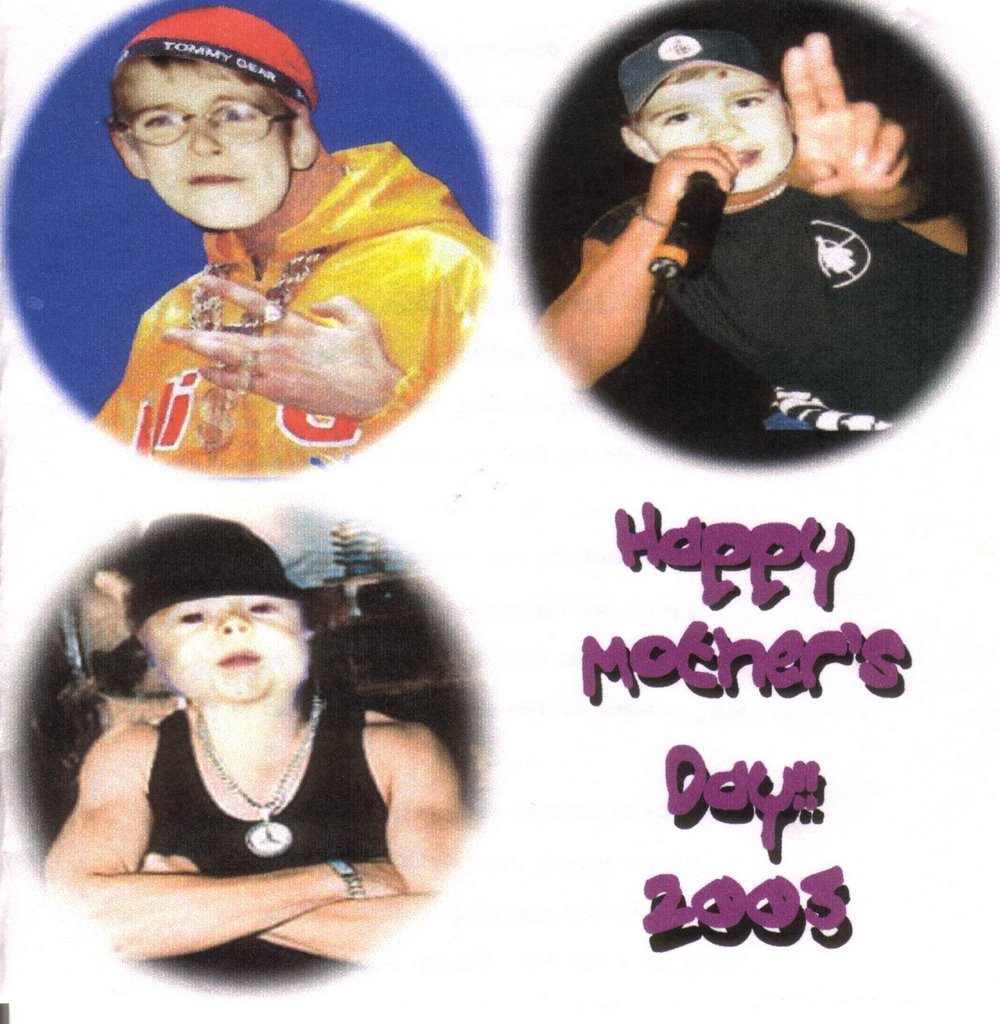
Suburban Man: Mother's Day Rap

When I was still working on the radio, my boys provided a constant stream of material. Every year on Mother's Day, we would go into the studio and produce an audio present for Bridget.

This one was probably my favorite Mother's Day present for Bridget. One long-time fan/listener of the show said it was her favorite bit we did in the ten years of the John Landecker Show on WJMK. It's a rap song starring all three boys. Tommy was seven. Johnny was five. Sean was nine months old. All three can be heard on this hilarious recording. Thank you to Vince Argento for his production magic (and artwork).

A few words of explanation: The words Johnny says in the song ("Allerticott" and "Baga") are Johnny's made up words--inside family jokes. He said them in fits of anger (allerticott) and for comedy purposes (baga).


Click on this link to listen to the song: Mother's Day Rap

It's short, less than a minute long.

This year with no studio, no production director, and no rap music library, we'll probably get her some flowers.


If you missed any previous Suburban Man columns, click here: http://suburbanmanarchive.blogspot.com

Saturday, May 05, 2007

Celebrity Snippets: George Carlin


Once a week long-time radio producer and author Rick Kaempfer shares his favorite brushes with greatness in a feature he calls “Celebrity Snippets.”


George Carlin is one of the most successful comedians of all time. He has done more comedy specials on television (mostly for HBO) than any other comedian in history, and has appeared in countless films and television shows. Ironically, my kids know him as the narrator of Shining Time Station on PBS, and the voice of "Fillmore" in the movie "Cars." This week he turns 70 years old.


By Rick Kaempfer


President Bush takes a lot of heat for accusing his opponents of “Pre-9/11” thinking. I never thought I would be writing these words, but I feel I must defend President Bush. Pre-9-11 thinking does exist, and it can have a detrimental effect...especially in the world of comedy.

My story involves comedian George Carlin.

I’ve always considered him on the finest comedians that ever lived. He is courageous, utterly unafraid of saying what he really thinks, and has been consistently funny for five decades now.

When we had him on the John Landecker show, I was not disappointed. He came into the studio with guns blazing, trying out brand new material that he hoped to include in his upcoming HBO Special.

The tentative name of the special at the time? “I kind of like it when a lot of people die.”

The date of his appearance on our show? September 4, 2001.

His routine was shocking even then (in a pre-9/11 world), but it was laugh out loud funny. We were holding our sides as he recounted the way he cheers when stupid people die doing stupid things and how he roots that they take down as many stupid people as possible with them.

Landecker and Carlin began riffing about stupid ways for people to die, and after the hilarious segment was over, George asked if he could have a tape of it so that he could use some of the material in his special.

Our station management thought it was such a funny interview, they submitted the tape for that year’s Achievement in Radio Awards. The tape went into the mail on September 9, 2001.

Needless to say, we weren’t nominated that year.

When Carlin’s special eventually did come out on HBO, it had a brand new name. It was called “Complaints and Grievances.”

Not quite as catchy, is it?

Timing is everything.


For hundreds of additional celebrity and radio stories, check out my book "The Radio Producer's Handbook," which is still available at Amazon, and Barnes & Noble.


If you missed any of the previous Celebrity Snippets, click here: http://celebritysnippets.blogspot.com

Tuesday, May 01, 2007

Suburban Man: Premature Jubilation


By Rick Kaempfer


My first novel, $everance, went to press yesterday. At the age of 43, I'm finally achieving my lifelong dream of becoming a published novelist.

How does it feel?

Well, I've discovered that the process of becoming a published novelist is really a series of premature celebrations. By my most recent count, I've celebrated the end of the process eleven times already-and my book isn't even out yet.

All of the following celebrations turned out to be a tad premature:

1. I celebrated when I figured out a way to weave my complicated plot together. I just knew it was all downhill from there. This book was going to write itself.

2. I celebrated when I finished my first draft. Six solid months of working on the manuscript every day-it was certainly all but over.

3. I celebrated when I finished my second draft-which I considered to be perfect. I just knew that I wouldn't have to change another thing.

4. I celebrated when I found a publisher. Granted, the publisher required a few minor plot changes-but that wouldn't be a big problem. I could see the light at the end of the tunnel.

5. I celebrated when I figured out how to implement her changes. All I had to do was rewrite the second half of the book. Surely that wasn't going to take too long. I knew these characters like the back of my hand. It was all but over.

6. I celebrated three months later when I finally finished writing the third draft. I clinked glasses with my wife right after I hit the send button on the email.

7. I celebrated again when my publisher emailed me a few weeks later, saying she was proud of me for pulling it off-and she was sending me a contract. That was it. It was all over.

8. I celebrated again after I signed the contract. Finally!

9. I celebrated again after she sent me the artwork for the cover. Now it seemed real. There, on a stylishly designed cover, was my name (with the more author-sounding first name "Richard," instead of "Rick") in big block letters. Clink!

10. I celebrated again after the editor sent me the final line-edits. This wasn't going to take long to whip into shape, and then we were ready to go.

11. I celebrated again when I finished those final edits, and got them approved. Okay, now it's time to break out that bottle of champagne we've been saving.

Of course, I still don't have a hard copy of the book. That will be premature celebration #12. I still haven't scheduled my book tour (#13). I still haven't seen my book on a bookshelf in a bookstore (#14), and I still haven't sold a single copy of my book, although I understand a few have been pre-ordered (#15).

I must admit that I feel a little more sheepish with each successive celebration, but I just can't help myself. I'm not just the boy who cried wolf-I'm the boy who cried wolf fifteen times . . . and counting.

When the true moment of celebration comes, my friends and family will think it's another false alarm, and I'll probably have to celebrate alone.

If you really think about it, though, wouldn't that be the most appropriate celebration of all? Writing is, after all, a totally solitary experience. Shouldn't someone who works by himself, celebrate by himself? If you look at it that way, my first solitary celebration will be my first truly appropriate celebration.

Which, of course, calls for a celebration.

Don't worry. I plan on checking into rehab as soon as the book tour ends.


This article first appeared in Shore Magazine (www.visitshoremagazine.com)


This is the Promotional Video for $everance.

If you missed any previous Suburban Man columns, click here: http://suburbanmanarchive.blogspot.com

Sunday, April 29, 2007

Chicago Radio Spotlight: Jeff Hoover


Once a week, I talk to a current or former Chicago radio personality for a feature I call: Chicago Radio Spotlight.


Jeff Hoover made his name in Chicago radio as one of the hilarious writer/performers of Jonathon Brandmeier's show in the 90s. He is now one of the producers of the highly rated WGN Morning News on Channel 9 in Chicago. A show Hoover helped produce for WGN-TV in 2005, "Bozo, Gar & Ray: WGN TV Classics," won three Telly Awards in entertainment, variety and documentary categories.


RADIO-OGRAPHY

News/Talk 1400 WSJM & Magic 107 WIRX
(St. Joseph-Benton Harbor) A Mid-West Family Broadcasting Station is very approximate - I would say it was probably 1984 - 1988

Jonathon Brandmeier Showgram WLUP/AM1000/WCKG 105.9FM. I was a contributor from '93 to '95 and hired as a creative producer in 1996 to 2001

Was a free-lance producer in 2002, and joined WGN Morning News as a producer in 2003.


Rick: I know you got your radio start in your hometown of St. Joe's in Michigan. Tell us a story or two about what it's like working at a small market station like that--compared to working in a market like Chicago.

Hoover: I worked at WSJM/WIRX during my summer breaks from attending Business School at Western Michigan University. I had a sweet lisp back then. I must have picked it from doing too much musical theater in high school. Anyway, the station tag line was "the Spirit of the Southwest." I have the airchecks and if you heard them, you'd swear that it was Garry Meier doing one of his Cliff Mansavage bits. We played soft rock music on reel-to-reels and I would read the weather forecast, blood drive information and let the elderly know what parking lot the Bookmobile was going to visit next.

Yes, I saved many lives in those days.

Rick: You made your name in town as a writer/performer on the Johnny B Showgram. How did you get your foot in the door there?

Hoover: First of all, I was (and still am) an avid fan of Johnny's for many years before I ever worked for him. I could hear the Loop on my boom box in Michigan.

Anyway, I moved to Chicago in 1991 and didn't get the idea to call in to his show until he had a Jerry Lewis impersonation contest in 1993. Johnny had tickets to see Jerry at the Drury Lane in Oakbrook. I was working at a marketing company and heard this and thought this was my chance to play. I asked the HR manager if I could use her office for a minute and closed the door and made the call. I had never tried to say anything more than "LADY" in the Jerry voice so I was nervous and anxious. Luckily, some of the Second City improv training kicked in when it came to my turn. After riffing about my colostomy bag looking like a Steakum, I won the tickets. Now, this is going to sound really dorky, but the greatest feeling during that first call was making Johnny laugh. I still have the tape and it is great to hear Johnny, Buzz and Robin together. And, to this day, the best thing that I can ever hope to do, is to make people laugh. Jesus, I really sound like Jerry Lewis now.

Since that day, anytime Jerry Lewis came up in the news, they would call me and see if Jerry was available. Soon, they'd call for Jerry even if he wasn't in the news. I was invited to remote broadcasts, too.


(I even got to sit on stage next to Andy the Clown and Jack Brickhouse at the Danny Bonaduce/Donny Osmond fight. One of them smelled like pee.)


One day, I thought that I should try and see if I could work on the show full-time. It was a long shot, but why not. I called his office and spoke with his Executive Producer, Carol "Lamb Lady" Harmon. She advised me that she didn't think that there was any position open at the time, but if I was serious, I should approach it like it was a business. Johnny is "just having fun" on the air, but off the air, he is a solid businessman. I sent a cover letter and resume. A few days later, he sent me a handwritten note on his letterhead that said "Timing is everything!"

Several months later, we talked on the phone. I decided to dump the suit and tie and 401K and get up at 2am to work for the funniest man in radio. My first day there, I was on the air doing a bit as James Mason in Hell. That was huge for me because Johnny hired me on nothing but my Jerry impression, Second City skills, marketing degree, and I was hungry. Johnny gave me my break to go nuts and drive the clown car.

Rick: Pretty soon you were doing all kinds of voices. You also did Bobby Brown, Bob Hope, Christopher Walken and many, many others. Have you always had a knack for mimickry, and has that gotten you in trouble over the years?

Hoover: First of all, you should know that I was a fat kid with a soup bowl haircut who circled the new Saturday Morning Cartoons that I planned to watch each Fall out of the TV Guide. I watched all of the old Abbott & Costello movies and the classic kids' shows on Channel 9. I watched Svengoolie and The Three Stooges. I watched so much television, my eyes were shaped like rectangles. So, I guess you could say that I was like a Mynah bird soaking in the sounds in front of the TV.

I never really got into trouble doing the voices. But, I did fool some "celebs" into thinking they were talking to Jerry Lewis (Bruce Willis, Bea Arthur, Charlie Daniels, Carol Channing, The Smothers Brothers, etc.)

I only felt bad one time. There was a story of this retired couple that live in Mud Lake, Minnesota and they were battling the city officials because they wanted to change the name of the lake from Mud Lake to Golden Pond, which happened to be their favorite movie. So, Johnny calls them up as Katharine Hepburn's caregiver and I am on the phone as Katie. The husband bought it, even though I was working a tad blue. Katie said that she would come and visit and help their campaign. Johnny was saying that I needed a parachute harness to be lifted around and Katie was saying that her diet consists of eating toothpaste and she wanted to bring her 37 cats, etc. They were excited. They were even contacted by their local CBS television news station and arranged for an interview with Katie.

We did the interview with the reporter and they all bought into it. Well, some listener ended up calling them and told them that Katie was a fake. Unfortunately, we didn't realize this until Johnny called them up to hear the audio from the television interview. The wife answered the phone and told us how ashamed we should be, especially since her brother had died during all of the excitement of Miss Hepburn's visit. The husband knew days earlier but didn't want to spoil things. Oopsy daisey.

Rick: Those aren't the only people you offended. I'm German, pal, and we weren't too thrilled with your Wilhelm the Stormtrooper character either.


Hoover: (laughs) I know nuthzing! The Stormtroopers were born out of the "mass firings" that were happening at the Loop when it was bought by the Mormons (Bonneville) and we suddenly became "the Best Music on the Planet." (Turns out that listeners didn't want to live on a planet where the song "Breakfast at Tiffany's" is played every quarter hour either.)

Wilhelm and Helmut (very funny Showgram Player Brendan Sullivan) would interrogate various people and fire them. We played it safe like "Hogan's Heroes." Johnny played audio of jackboots marching up and down the hallway. It was all fun and games until we started making bar appearances and some schweinhund sales guy booked us at a place in Skokie. Hello? Is this mic on?


Rick: How did it work on Brandmeier's show? Did you and Brendan come up with ideas and pitch them to Johnny or did he come to you guys and say..."Hey, I need Jerry Lewis to call Charo!"...or was it a little of both?


Brendan (photo) was there before me. He was actually one of the writers that worked on Johnny's television show. Johnny liked his stuff and hired him to work on the radio show. He was a one-man band. Jimmy Mac was doing the wacky edits and Artie Kennedy was doing Mike Tyson and showing off his dead-on Demi Moore pregnant pose. But, Brendan was alone in the creative department. When I came onboard, it could have been very awkward or competitive, but we clicked very well and we knew right away that the best way to get the job done was to work together and bounce ideas off one another as a team. Some ideas were Johnny's and some were ours. It didn't matter as long as it was funny. As Johnny would say, bake the cake, find the meat, keep your head down and stay focused. Johnny likes to keep it real. Real is funny. A guy who invented a machine that sucks up prairie dogs is more entertaining than the best comedian or biggest star in his mind. That's the meat to him. The rest is frosting. So, frost the meat. Huh? Nevermind.

Rick: After the Johnny B show ended at WCKG, you had a hard time finding something else in Chicago radio. I tried to convince my bosses at the time to hire you and they just didn't have it in the budget. Do you think that says something about the kind of radio being done now in Chicago, or was it just one of those cases of bad timing?

Hoover: I think some radio people didn't know what to do with me. Hell, I had Johnny's hand comfortably up my puppet pooper so long, I think that most Chicago radio shows didn't know what else I could do. So, I sent out my resume and tape to other dream job long shots like Letterman and Conan.

The only callback I received was from the producer of The Howard Stern Show. Gary Dell'Abate (photo) said that Howard loved my stuff and wanted to know how I worked. It was perfect timing because Jackie the Jokeman had left in a huff over money and they were looking at rotating in different comedians, writers, voice guys, etc. The Labor Day Telethon was a week away so I suggested that we try a "Jerry Lewis" bit with Howard and see what happens from there. We did it. It went great and even nominated for an F Emmy later that year.

However, I think Gary probably saw me as a threat since I did more than write bits and do voices. I booked some guests and came up with giveaway ideas, too. So, I sat around drinking way too much coffee in the morning and started watching WGN Morning News. It was like a great radio show ensemble, but on television. Me likey.

Rick: I know you're too modest to admit this, but you've really made your mark on the WGN Morning News. This is just my personal opinion, but I think that show took it to another level when you came aboard. Tell us a little bit about what you do on the show.

Hoover: Wowie-wow-wow. That is way too kind. This show was fast, fun and funny before I ever showed up here. In my opinion, no other station in town can pull off what the talent does on this show. I fell in love all over again watching this show. I never thought there could possibly be anything close to the experience I had with Brandmeier. I was wrong.

One moment, Larry Potash is doing a hard news story about Iraq and by the time the next Victory Auto Wreckers commercial is on, he is up on the desk doing the Fred Sanford shuffle. He's the only anchor in town that can pull that off. Although I think I saw Ron Magers do the Macarena once.

So, I started emailing and leaving goofy voicemails. They started using my ideas and playing my messages. After several months, Larry said that he wanted to try and get me an interview with the news director. It was a perfect opportunity to show that the skills I had learned working in radio were transferable in many ways to producing for television. Breaking the sameness barrier is important. Finding ways to do old things and make them new again. I think that the one thing we do better than anyone else is to be real people. No fake small talk tosses to weather and traffic. They are quick to break each others hump and aren't afraid to let viewers see all of the wheels come off the show. I also believe that between Larry, Robin Baumgarten, Paul Konrad, Ana Belaval, Dean Richards, Pat Tomasulo and Valerie Warner, we have the best morning news team in town, and it's reflected in the show's ratings.

Granted, our show is not for everyone. But, hopefully Sam Zell likes it.

Rick: Talk about the differences between working in radio and television.

Hoover: Radio is more spontaneous. To appear to be spontaneous on television sometimes requires 29 people to know what you are going to do ahead of time. But that is also why television is more exciting. Everything is there to be seen and there is so much more that can go wrong. And some of the best stuff happens by accident.


Rick: Tell us the dirty dark secrets about Paul, Larry and Robin.


Hoover: Well, it's not that dirty or dark, but it's stuff you probably wouldn't guess about them.

Paul Konrad is one of the most naturally funny men I have ever worked with in my life. He is quick-witted and his sense of humor is effortless. What you don't know is that in our post-show meetings, he actually has a great news brain. He offers a lot of suggestions in the meetings about newsmakers and story angles that we might have missed. He also has a third testical under his left armpit.

Larry Potash is the best all around talent in television morning news. He can do it all. He can hold down the fort and find the funny in the same breath. What you don't know is that he is a workaholic. He works late after the show and from home. He also works during his sleep which is also when we are on the air.


Robin Baumgarten is the real deal. She is South Side. She likes to knock back a few beers and smoke a heater. She's not afraid to speak her mind. She kinda reminds me of my Dad when I'd have my friends over to the house and he'd be in the garage working on the car and his ass crack would be showing, and I'd ask him to pull up his pants and he'd say "if you don't like it, don't look at it."

What you don't know about her is that she is really sweet underneath it all. She also will probably kill me for comparing her to my Dad's crack.

Wednesday, April 25, 2007

Half Empty: Community Showers


They say that when you hit your 40s, your life is half over. We prefer to think of it as HALF EMPTY. Our age has finally caught up with our outlook on life. Remember, it is possible to turn that frown upside down...but you might pull a muscle.


By Rick Kaempfer & Dave Stern


Concerned reader “B” writes:

“Do you belong to a gym?

I have this one pet peeve that has really been bothering me lately.

I have spent my entire life trying to keep men from being behind me when I am naked. When I get out of the shower at the gym and am drying off, guys will often walk past me on their way to the shower. Most will walk in front of me, but some insist on walking behind me.

Being naked and sometimes bending over to dry various body parts, I find it disturbing to have a naked man behind me when I am at my most vulnerable. To combat this, I try standing closer to the wall so that they will walk in front of me. Sometimes even this doesn’t work.

Naked guy literally has to turn sideways to get through when there is 10 feet of open space in front of me. WTF!

Also, when I am naked, don’t talk to me. Some guy said something to me while I was in the shower at the gym. Of course I couldn’t hear him because I was in the shower. That means I have to go over to hear him say “I like your rings” and point to my earrings. I’m strongly considering going back to work without showering.

What do you guys recommend I do?”

Well, "B," we understand why you would bring this problem to our attention. You can probably tell by looking at us that we’re both gym rats who spend quite a bit of time working out. We certainly weren’t born with these guns and abs.

Let us address your concerns, point by point.

Unlike women, who enjoy lathering and soaping each other tenderly in the shower (we’ve seen the movies), men are not big fans of touching or looking at each other while nude. It begs the question—Why hasn’t anyone spelled out the etiquette rules to avoid this most uncomfortable situation?

There's no excuse for that oversight.

That's why today, we're officially posting the "Unofficial Community Shower Rules For Men." Men, follow these rules to the letter and no one will be hurt or blinded.


Rule #1: Never walk behind a nude man when you are also nude.

What if you slip and fall forward? That’s the sort of forceful bodily contact that will haunt you forever. If it’s impossible to pass by another nude man without allowing at least ten feet of space, stay where you are until he leaves.

Rule #2: Conversations among nude men are strictly forbidden.

Think of the potential problems. “B” points out the problem of not hearing well when the water is running, but that’s just the tip of the iceberg. Even if you can hear the other nude man, what are you doing with your eyes? If you maintain eye contact, you will creep him out. Nobody likes unflinching eye contact like that. You’ll probably make the other nude guy so uncomfortable, it will force him to avert his eyes, and then…what is he looking at? If you don’t maintain eye contact, it’s even worse. It's best to pretend like the other guy isn't even there.


Rule #3: Hurry up, dammit.


The only acceptable thing to do in the community shower is to get in, wash as quickly as possible without washing certain areas as thoroughly as you normally would in one of your longer showers at home, go back to your locker without coming within ten feet of another nude man, dry as quickly as possible, and then get your clothes on as quickly as possible.

Rule #4: Resume normal activities only when fully clothed.

When every man within ten to fifteen feet is also clothed, you may return to your normal social activities. At this point, a high five, and/or a fist-bump would be perfectly acceptable.


How is it possible that these rules have never been spelled out before?

Without rules and boundaries, group male nudity has been known to take weird and unexpected turns. How weird? Well, when Dave was still in high school (Lane Tech in Chicago), his gym teacher made the boys take nude group showers before group nude swimming, followed by more group nude showers….but he made them wear swimming caps.

Dave’s community shower career has also been touched by celebrity. When Dave attended the University of Illinois, he shared a dorm floor community shower with two well known Fighting Illini basketball players (both of whom eventually played in the NBA.). Isn’t it wrong that Dave knows details about these two gentlemen that most groupies won’t find out until they camp out in a hotel lobby and volunteer to bring up room service with a “special” dessert?

If society insists on maintaining community showers, we have a suggestion for improving the concept. Instead of having men shower with other men and women shower with other women, community showers should be strictly coed.

Settle down girls, we hear your concerns.

We know you gals would miss soaping and lathering each other, so that activity would still be permitted. We won’t mind. Honest. Not in the slightest.

On the other hand, you could also simply soap and lather men instead. Don’t forget, men will need extra attention after their previously rushed showers. A little expert soaping and lathering would be good for everyone. It’s win-win.

It’s the only way to keep America clean, safe, and comfortable.

Think about it America. The time has come.


If you missed any previous Half Empty columns, click here: http://halfemptyarchive.blogspot.com

Sunday, April 22, 2007

Chicago Radio Spotlight: Ed Schwartz


Once a week, I talk to a current or former Chicago radio personality for a feature I call: Chicago Radio Spotlight.


For three decades, Ed Schwartz was a late night radio institution in Chicago. They didn't call him "Chicago Ed" for nothing.


RADIO-OGRAPHY


WLS-AM 890 1965-1966


WIND-AM 560 1966-1982


WGN-AM 720 1982-1992
(See Ed on the WTTW special Radio Faces during his WGN heyday. The show aired in 1989. Thanks to Mediaburn, for the video.)

WLUP-AM 1000 1992-1996

Since leaving WLUP after it was sold, Ed has been a newspaper columnist. He wrote a column for Lerner until 2001, and has been a free-lance writer, mostly for the Daily Southtown, ever since.


Rick: First of all, I know your health has been a concern in recent years. How are you feeling?

Ed: I'm feeling like Sam Zell's Tribune bid: 334 million bucks. With the humor now established let me truthfully say I'm feeling good. About a year and a half back I was stunned to learn I was going into renal failure. That means the kidneys going on permanent vacation. It was a total surprise. No obvious signs or symptoms. There are two basic ways to attend to it. One is a kidney transplant and the other is kidney dialysis. I'm doing the dialysis course at the moment.

Three times a week I buzz over to the Lincoln Park Dialysis Center. It's a 4 hour committment, and is painless. I get to plant myself in a recliner in front of a small color tv equipped with stereo phones and I watch the tube. Also a good time to read or gab on the phone or catch 40 winks. So 12 hours a week are devoted to dialysis. If you follow the program you can lead a fairly normal life.

Rick: Columnists Robert Feder (Friends rally around 'Chicago Ed' in need) and Eric Zorn (Behind the musings: Eddie Schwartz) both put out public pleas for help on your behalf last year. What sort of a response did you get, and how did that make you feel?

Ed: You really find out what kind of friends you have when a really serious situation overwhelms you. Robert and Eric are both long time friends and they used their pulpits to spread the word that a group of my friends and former radio colleagues had joined together to support me. It was much more than raising funds. They were there when I was frightened about the future, worried about the treatment and not sure if I could even handle all that was occuring. I guess I was a bit "shell shocked" by the seriousness of the diagnosis.

Radio friends and special people such as Dave Baum, Clark Weber (shown here), Cheryl Morton, Mitch Rosen and Paul Heinze put together a Radiothon to help defray the costs of setting up a dialysis regimen. The fund they made possible thanks to contributions is what saved my bacon without a doubt. While I'm fortunate to have adequate health insurance the number of dollars for related costs not covered by insurance are pretty large. We sent every contributor a thank you, and it was from the heart.

The results of the Radiothon, a five hour broadcast on WSCR were gratifying. Lots of friends and former listeners called in to wish me well and many sent along a contibution to help me at a most difficult time. When first mentioned to me, the public fundraiser idea made me uncomfortable. I had spent my professional life participating in a number of efforts to aid people with problems and it was difficult for me to accept the fact that in this instance my role would be reversed and I had become the needy one. Dave, Clark, Paul and Mitch kept calling and coming to the hospital to convince me there was no reason not to let them help because if any of them was so afflicted they knew I'd be there for them. So the Radiothon was born, and it saved my keister for sure. Life is all about relationships. Don't leave home without them.

Rick: You made your mark in Chicago as the all-night guy at WIND. You were there for 17 years. Tell us the story about you came to WGN, and how Bob Collins and Larry King tie-in to that move.

Ed: During a very long and successful run at WIND 560 Bob Collins from WGN invited me out to dinner. He shared his hopes for the future. The retirement of Wally Phillips was on the horizon and Bob knew the WGN morning show was going to be his biggest challenge. Replacing an icon like Wally was no small assignment.

Uncle Bobby knew how to read a rating book and he realized that WIND was #1 in both male and female demos and had been so for years. He wasn't looking forward to hitting the air every morning with a competeing station having a larger audience. He knew it would take him longer to get each morning off the ground with a 3 or 4 share when WIND had 12's and 14's. So Bob proposed I join him at WGN and work overnight as his lead-in. I was a bit stunned, but it was something I had always hoped for and didn't know how to make happen. WGN was the home of Franklyn Macormick, Jay Andres, Mike Rapchak and the Meister Brau Showcase. My kind of act had never played there at night.

The opportunity Bob presented came at the perfect time. WIND had just welcomed a new G.M. He was a corporate guy from back east. The station was doing well with all time slots well established and this new dude comes in and tells us it's his station now and we all better get used to his ways. He also told us he was looking at the entire schedule with the possibility of juggling some of us around. I knew at that moment I wasn't going to put my future into the hands of a guy with his poor people skills. I had my agent make a deal and a few days after my WIND contract expired without a new deal ready it was the time to jump. I called a friend with a truck and one night after my show I just moved out and never said goodbye. It was a tough but correct decision.

WIND was scrambling to replace me and Larry King's program which had been on for a while at WCFL with no perceptible audience so WIND made him a pitch and his syndicated show moved into my old slot. King, when asked by Irv Kupcinet in the Sun-Times how he intended to procede said that "He wasn't concerned about me and my program. I spent most of my time interviewing the sewer commissioner."

The next day one of his minions called to "apologize" for the unkind remark and said that Kup misquoted King. He said Larry didn't really mean that. I knew from that point my mission was three-fold. 1. Build an audience 2. Support Bob Collins and 3. Kick King's ass bigger than he'd ever been kicked before. And that is just what I did. He was a total failure on WIND. He is the most ill-prepared interviewer I've ever seen or heard.


Rick: For nearly three decades you were the overnight guy at WIND and WGN. I know it's almost impossible to pick out a few examples or highlights, but are there any moments that really make you look back at with pride all these years later?

Ed: Actually my on-air years included WIND,WGN and WLUP AM-FM for a total of just about 29 years on the radio every day. There are many moments I fondly recall, but I think the most important was the establishment of the "Good Neighbor" Food Drive. It was a very sincere effort to help those less fortunate. Over the years we raised millions of pounds of foodstuffs and several million dollars.

My other prideful feeling comes from just being there every night and developing a bond with the listeners. I have a very personal style and it works. I worked every holiday to make sure my listeners had something dependable when the rest of the world was off I was there. Every Christmas, New Years Eve and all the others. It was well worth it.

Rick: As a rival producer, I was always amazed at the A-list celebrities that you got to appear on your show, and many of them came on quite often. Did you have any favorites? Were there any that you really felt didn’t click with you?


Ed: I was always prepared for my guests. I did my homework and they appreciated that. I would go over biographies, history, and whatever I could find to help bring more out of the guests. They liked to see an interviewer that didn't do it on the fly like lazy Larry King.

Not only did I have some favorites, but some of them became personal friends and because of that were always available to me. Some of the guests who became friends included: Stan Freberg, Steve Allen, Bill Cosby, Phyllis Diller, Myron Cohen, George Carlin, Dennis Franz, Bobby Vinton, and Mrs. Richard J. Daley. I was the only program Sis Daley would ever go on. She was a special friend.

During the campaign for Rich Daley's first winning term I had him booked one night before the election. His people called in about an hour before show time to say he just couldn't make it. I had promoted the hell out of it and wasn't going to let him welch. He knew his mother and I were buds, so I called his campaign manager and I said "I want him here at 11 o'clock or my next call is to Sis Daley." I hung up. Promptly at 11 he walked in and sat down. He waited until a commercial and then said "I hope you didn't call my mother. She'd kill me if I didn't show up."

I was also very close to Prof. J. Allen Hynek the Northwestern Astronomer and UFO expert. I'll tell you a secret that solidifed our friendship and caused him to include me at length in two of his books.

Allen Wrote a fascinating book called "The UFO Experience". It was in this book that he categorized for the first time the important of UFO sightings with the terms: "Close Encounters of the first, second and third kind". You will recall the Steven Spielberg blockbuster 'Close Encounters Of The Third Kind".

This is the rest of the story. Shortly after his book came out and long before any such movie was conceived I was in Los Angeles to tape some celebrity interviews. I bought a copy of the Hollywood Reporter to read when In arrived and in it there was a paragraph of just a few dozen words telling of Stephen Spielberg's next movie project. He was about to go into production of a UFO film and the working title was "Close Encounters Of The Third Kind". I was stunned. Dr. Hynek hadn't told me or anyone that he had sold the rights to his book for a movie. I called him from my hotel that night and asked him when he had made such a whopper of a deal? He didn't know ANYTHING about it. No sale was made, no permission obtained. Somehow Spielberg had come up with that title as if it were in the public domain.

Dr. Hynek wrote down the little story as I dictated it and said he was going to call his lawyer a.s.a.p. As a result of my call to him his book was in fact "bought" by Spielberg, as it should have been. Dr. Hynek not only was given credit for the title, but he was hired as the films technical advisor and he even appeared in the movie too.

I have many stories like this. I think I better write a book.


Rick: You left WGN in the early 90s to join the all-star lineup at WLUP. In retrospect, would you make that move again?


Ed: Under exactly the same circumstances, yes. I loved every minute at WGN, make no mistake. It is a very special place to me. Simply put, when my last contract expired the Loop offered me a job. The facts were presented to my bosses. All they had to do to keep me was was offer me 1 dollar more than the LOOP. They refused to let anything or anybody influence their decisions. They didn't take me seriously because NOBODY ever left. I never expected to myself. I could have put 20 or more years in there easily. I was actually very mad at their stupid gamesmanship. But it also gave me a chance to re-energize myself in a new environment and to work with some great people. I can't say enough about the talent of people like Wendy Snyder, Kathy Voltmer, Johnny B, Mitch Rosen who came with me as producer from WGN and a bunch of other folks who made working there a ton of fun. That includes the former GM and my boss Larry Wert.

Rick: What did you think about Kevin Matthews parody band tribute to you, Ed Zeppelin?

Ed: It bugged me at first. I couldn't figure out if it was meant to be funny or something less kind. When I got to know Kevin (shown here) I realized it was just a put-on. He is a unique talent. His voice work is remarkable. He can conduct a conversation with himself and two or three other character voices without stepping on himself. Seamless work like that is brilliant.


Rick: So many of your former co-workers still work in radio today. Do you still follow their careers and stay in touch with them?


Ed:
I do keep in touch either by phone or e. mail with quite a few people in the broadcasting community. In fact you would be totally shocked if you knew who several of them are, but I won't tell. Sadly there are far more radio people not working than sitting in front of local mic's. That is a crime.


Rick: Since leaving radio you've become a columnist and writer. I know you were joking about it earlier, but you really are writing a book, aren't you? Tell us a little bit about that...

Ed: I was a writer in grammar school and high school. The college years were devoted to radio but I never lost my love of the word. I write all the time. Space is so tight in the local print community that free lance work really has to be top drawer to get considered. I have had good luck in that regard but it's never enough for me. I could write every day if given the opportunity. My computer skills are now very sharp. I spend many hours on the Internet and the computer. It is totally intoxicating. I'm on my third computer. If I had this technology when I was in high school and college I can't imagine where I might have gone. As to my writing a book, I have a way to go, and who knows if anybody will care about it besides myself? But I've got some funny and yet untold stories, so I hope to get it done.

Rick: Last question. You are known as “Chicago Ed” because you championed local issues. What do you think about the job Chicago radio is doing on local issues today, and is there anyone on the dial who you think carries on your legacy?

Ed: The local elements of radio are about gone. With the exception of WGN and NPR, everything else is pretty homogenized. There are few really strong programmers around anymore. This syndication stuff erases the local importance of radio by eliminating the local coverage of almost everything.

Outfits like Shadow and the other traffic joint have aided the broadcasters in destroying the career path of radio. All these underpaid often inexperienced "news and traffic" voices that rotate thru the market are just more platforms for the sales guys to pitch. Everybody sounds the same, uses the same info and makes the same mistakes.

I love radio and I'm sad to hear what's no longer happening on the dial. I can't think of anybody on here today who does what I did. I'd love to go back tomorrow and show them how it's done. This is not ego talking. It's experience.