Musings, observations, and written works from the publisher of Eckhartz Press, the media critic for the Illinois Entertainer, co-host of Minutia Men, Minutia Men Celebrity Interview and Free Kicks, and the author of "The Loop Files", "Back in the D.D.R", "EveryCubEver", "The Living Wills", "$everance," "Father Knows Nothing," "The Radio Producer's Handbook," "Records Truly Is My Middle Name", and "Gruen Weiss Vor".
Showing posts with label Just One Bad Century. Show all posts
Showing posts with label Just One Bad Century. Show all posts
This year marks my 20th year as a professional writer. Over the course of 2024, I'll be sharing a few of those offerings you may have missed along the way.
One of the most disturbing things I discovered during my research for EveryCubEver (my 7th book) was that the Cubs actually got first crack at signing one of the all-time greats, Joe DiMaggio.
I wrote about that story for Just One Bad Century...
Joe DiMaggio
He was never a member of the Chicago Cubs, but he could have been. That’s right: The Chicago Cubs passed on Joe DiMaggio. Is there anything that sums up a bad century better than that sentence?
The sad part of the story is that it was even worse than it sounds. In the off-season between the 1934 and 1935 seasons, the Chicago Cubs were offered Joe DiMaggio by his minor league team, the San Francisco Seals. DiMaggio had a minor knee injury at the time (he banged his knee stepping out of a cab), and the Cubs were scared off by that injury. They didn’t want to commit any money to someone who might have been damaged goods.
Understandable, right? It was even understandable to the owner of the Seals. That’s why he upped the offer. He told the Cubs they could have Joe DiMaggio for spring training in 1935, and if he wasn’t 100% recovered, and he wasn’t 100% the player the owner promised he was, the Seals would gladly take him back and refund every dime the Cubs paid for him.
P.K. Wrigley had just finished his third season as the owner of the Cubs and thought he understood the game better than his baseball guys. He looked at his outfield (Chuck Klein, KiKi Cuyler, and Augie Galan) and decided that the Cubs didn’t need another outfielder. He passed on the offer.
The Yankees did not. They signed him in December of 1934 for $25,000.
While it’s true that the Cubs made the World Series in 1935, one of those outfielders Wrigley was counting on (KiKi Cuyler) was released before the season was over. Another one, Augie Galan, was a converted infielder with a weak arm. He made a crucial error in the 1935 World Series that cost the Cubs a game. The third one, Chuck Klein, was traded the following season; 1936.
That was DiMaggio’s rookie year with the Yankees. All he did that season was lead the Yankees to a World Series championship. The following year he did it again. In 1938, he not only led the Yankees to the another championship, he beat the Cubs with a ninth inning home run at Wrigley Field to seal Game 2 of the World Series. Before he was through playing in New York, DiMaggio was a 13-time all-star, a nine-time World Series champion, a two-time batting champ, a two-time home run and RBI champ, a three time MVP, and the holder of the all-time hitting streak record of 56 games. Oh, and he married Marilyn Monroe.
This year marks my 20th year as a professional writer. Over the course of 2024, I'll be sharing a few of those offerings you may have missed along the way.
The baseball playoffs are underway, and once again, the Cubs are not in it. Wrigley sits dormant. But it hasn't always been that way at Wrigley in October. I've written about it many times in many ways.
Here are a few stories from some of those games that occurred this month in history at Wrigley Field.
October 1, 1932
The most famous moment in Wrigley Field history occurred. Or did it?
It was Game 3 of the World Series. The Yankees had won the first two at Yankee Stadium. Soon-to-be President Franklin Delano Roosevelt (sitting next to Chicago mayor Anton Cermak) threw out the first pitch. In the stands; a young boy named John Paul Stevens, who would go on to become a Supreme Court Justice.
The 1932 Yankees were a riled up team who hated the Cubs for dissing one of their former teammates. Mark Koenig had replaced Cubs shortstop Billy Jurges during the season after Jurges was shot by a fan. Despite hitting .353 during the season and saving the hides of the Cubs, the players voted not to give him a full World Series share. This really angered the Yankees, especially their emotional leader Babe Ruth.
He was ticked off and let the Cubs know it in no uncertain terms.
Did Babe Ruth really call the shot? Almost certainly not. The writers said he did, and he played along with it, but he also privately acknowledged that he never would have done that to Charlie Root who was known as a ruthless headhunter. Charlie swore to his dying day that Babe did not call the shot.
According to the Cubs players, Ruth was being taunted by the Cubs dugout (who should have had their heads examined after they already ticked off the Babe). Ruth was more than likely pointing at the dugout, gesturing that he still had one strike left. That may have looked to the writers like he was calling his shot. Plus, the writers said he pointing to left–but he hit nearly all of his homers to right, and the actual homer went to deep centerfield…an unusual location for a homer by the Babe. The called shot is probably nothing more than a legend.
Nevertheless, part of the legend is true. He did homer. And Gehrig homered right after that. And they both homered again later in the game.
The 1932 World Series was a 4-game pummeling. But as famous as that supposed “called shot” was, Babe Ruth was not even the player of the series. Lou Gehrig hit .529, and would have been named the MVP if they had such an honor in those days.
October 1, 1950
Andy Pafko puts the finishing touches on a great season. Joe DiMaggio is probably known as the greatest player in baseball history to possess both power and patience at the plate. In four different seasons he actually had more homers than strikeouts. His final career numbers are absolutely jaw dropping: 361 homers, and only 369 Ks.
One Cubs player also had that same combination of power and patience, and his 1950 season in particular can only be described as “DiMaggio-esque”.
That year Andy Pafko knocked the ball out of National League ballparks 36 times while only striking out 32 times. Only 14 players have ever accomplished that feat: Ken Williams (1922), Lefty O’Doul (1929), Mel Ott (1929), Al Simmons (1930), Lou Gehrig (1934, 1936), Joe DiMaggio (1937, 1938, 1939, 1940), Ted Williams (1941), Willard Marshall (1947), Johnny Mize (1947, 1948), Stan Musial (1948), Yogi Berra (1952, 1956), Ted Kluszewki (1953, 1954, 1955, 1956), and Barry Bonds (2004).
Pafko’s 1950 season was so impressive that Reds’ president Warren Giles said if he could choose any player in the National League to help improve his team, he would choose Pafko.
Naturally, Handy Andy was rewarded for that incredible season in true Cubs fashion. He was traded to the Brooklyn Dodgers.
October 1: In 2008 Ryan Dempster walks the bases loaded then gives up a grand slam to James Loney as the Dodgers beat the Cubs in Game 1 of the playoffs.
###
October 2, 1984.
The Cubs played their first playoff game in 39 years.
The 1984 Cubs won the division going away with the most wins in the National League (96). They had the most exciting young player in the league (MVP Ryne Sandberg). They had a team of veterans (Cey, Moreland, Bowa, Sutcliffe) that had won championships before. With that entertaining cast of cast of characters, and Harry Caray at the microphone broadcasting every single game on a Superstation (WGN), the 1984 Cubs were America’s darlings.
The first game went exactly as planned. Cy Young winner Rick Sutcliffe shut down the Padres on the mound, and Cubs batters immediately took it to San Diego. In the bottom of the first inning lead off man Bob Dernier cracked a homer, and two batters later Gary Mathews did the same. He later hit another one, as did Ron Cey, and even the pitcher Rick Sutcliffe joined in on the fireworks display.
At the end of the game the scoreboard said: Cubs 13–Padres 0.
America’s darlings were well on their way to the title.
Right?
October 2: In 1932, the Yankees sweep the 1932 World Series with a crushing 13-6 victory. Future Cub Tony Lazzeri hits 2 homers for the Yanks. In 2001, Sammy hits his 60th homer in a 5-4 loss. In 2008, every single Cubs infielder commits an error and the Dodgers take a commanding 2-0 lead in the five game NLDS series. In 2018, the Rockies outlast the Cubs in 13 innings to win the Wild Card game, 2-1. In 2020, the Marlins came in and did the same thing, knocking the Cubs out of the wild card series with a 2-0 win.
###
October 3, 1976
Ken Griffey’s final game of the 1976 season is a cautionary tale for anyone who tries to take the conservative way out to win the batting title. He was leading the league in hitting on the second to last day of the season, and when someone did the math, it looked like there was no way he could lose it. The second leading hitter, Bill Madlock of the Cubs, would have to go 3 for 3 or better to steal it away. Going with the odds, Griffey was rested on that last day to secure the title.
Unfortunately for him, Bill Madlock decided not to follow the script. He got hits in his first three at-bats of the Cubs game, and word reached Griffey in the Cincinnati dugout that his batting title was at stake. So, he came into the game as a pinch hitter and made an out. Madlock, on the other hand, got another hit, ending his day 4 for 4.
The batting title went to Bill Madlock, his second batting title during his Cubs career.
The 1976 Reds went on to win the World Series that year, while the Cubs finished in the cellar. And, after the season ended, Cubs owner Philip K. Wrigley authorized the team to trade Madlock so that he wouldn’t have to meet his salary demands. (The Cubs traded him to the Giants for Bobby Murcer.) But Ken Griffey Sr. played another fifteen big league seasons and never won the batting title.
October 3: In 1930 the Cubs win a rare game in the City Series against the White Sox.7. In 1998, Kerry Wood faces Greg Maddux in the playoffs, and Maddux comes out on top to sweep the Cubs out of the playoffs. Wood will miss the entire 1999 season because of an injury. In 2000, Jon Lieber wins his 20th game of the season, 13-7 over the Reds.
###
October 4, 1989
If you look at the roster of the 1989 Cubs, you realize that they had no business making the playoffs that year. Even manager Don Zimmer and general manager Jim Frey thought they would win about 70 games. Two thirds of the starting outfield were rookies–Jerome Walton and Dwight Smith. Rookie catchers Damon Berryhill, Joe Girardi, and Rick Wrona split time behind the plate. The third basemen were Vance Law and Luis Salazar. But somehow, with this group of players and the veteran presence of Ryne Sandberg, Andre Dawson, and Mark Grace (who was actually quite young too), the Cubs caught lightning in a bottle.
This motley group became known as the Boys of Zimmer. Don Zimmer’s unorthodox managing style confounded his opponents all year, and with smoke and mirrors the Cubs won the division. Mark Grace led the team with a whopping 79 RBI. The rookies played way above their heads. Jerome Walton was the rookie of the year and had a 30-game hitting streak. Dwight Smith hit .323 in left field sharing time with converted catcher Lloyd McClendon. Shawon Dunston became a sensation with his frightening arm at shortstop, and the entire city followed his batting average thanks to the Shawon-O-Meter; maintained by a bleacher fan. A crazy kid reliever named Mitch Williams had the most terrifying saves imaginable–yet he pulled it off time and time again. And a young pitcher emerged to lead the starting rotation…his name was Greg Maddux.
Still, this team had no business being in the playoffs and they discovered that pretty quickly. The Cubs were clearly overmatched by the Giants, who sported a lineup featuring the likes of Will Clark, Matt Williams, and the MVP of the league–Kevin Mitchell. They say that good pitching always beats good hitting, which can mean only one thing. The Cubs didn’t have good pitching.
Greg Maddux was torched in Game 1. The Cubs lost 11-3. The worst moment of the game occurred when Don Zimmer came out to talk to Maddux just before Will Clark came up to bat. The first pitch after the mound visit was crushed for a home run. Clark later said he read Maddux’s lips and knew which pitch was coming. That moment sparked the trend of pitchers and catchers covering up their mouths with their gloves when they talk.
October 4: In 1935, the Cubs lose Game 3 of the World Series to the Tigers, 6-5 in 11 innings. The Tigers have a 2-1 lead in the series. In 1992, Andre Dawson hits his last homer as a Cub, and the 399th of his career.
###
October 5, 2003 The Cubs won their first playoff series since 1908. Kerry Wood was on the mound in Atlanta, facing off against Mike Hampton.
Cubs leadoff man Kenny Lofton got the ball rolling immediately, scoring in the top of the first on a Moises Alou single. The Cubs added a second run in the top of the second on an Alex Gonzalez home run, and then padded the lead in the sixth on a two-run homer by Aramis Ramirez.
Kerry Wood did the rest. He struck out seven, allowed only one run, and was named the MVP of the series. (He had also won Game 1 in Atlanta).
The Cubs didn’t win another playoff series until 2015.
October 5: In 1935, the Cubs fall behind 3 games to 1 in the World Series after the Tigers beat them 2-1 at Wrigley. In 1938, Cubs ace Bill Lee loses Game 1 of the World Series to the Yankees, 3-1. In 1980, Bill Buckner wins the batting title. In 1989, the Cubs beat former Cub Rick Reuschel 9-5 to even up the NLCS at 1 game apiece. Mark Grace is on fire.
###
October 6, 1938 The Cubs were playing in the World Series against the New York Yankees at Wrigley Field. The Cubs had dropped the first game of the series, but for Game 2 they had their old warrior Dizzy Dean (photo) on the mound.
The Cubs actually had the lead going into the 8th inning. Somehow, the cocky Dean was getting them out with nothing more than guts and guile. It really looked like he may have one more miracle left in that bag of tricks. Then the Yankees came to bat in the top of the eighth. Leadoff man Frankie Crosetti knocked a ball out of the park, and the Yanks took a slim lead. The score was 4-3 in the ninth, and ol’ Diz took the mound one last time.
Tommy Heinrich led off the inning with a single, and Joe DiMaggio came to the plate. DiMaggio was the most feared hitter in baseball that year, and it didn’t take Dizzy Dean too long to figure out why. He easily cleared the left field wall with a mammoth shot, and the Yanks sealed the win. Dizzy was yanked from the game, never to return to the big stage again.
After losing those first two games in Chicago, the series was essentially over. The Yankees beat Clay Bryant 5-2 in Game 3, and then clobbered the Cubs in Game 4 for an easy four game sweep.
October 6: In 1935, the Cubs win Game 5 of the World Series against the Tigers, 3-1. Cubs ace Lon Warneke gets the win. In 1945, the Tigers tie up the series by beating the Cubs 4-1. Dizzy Trout (father of Steve) wins the game. In 1963, the Bears beat the Colts 10-3 on their way to the NFL Championship. In 2007, the Diamondbacks sweep the Cubs out of the playoffs.
###
October 7: In 1945, the Tigers go up 3 games to 2, by beating the Cubs 8-4. In 2001, Sammy Sosa hits his 64th homer of the season in a 4-3 loss to the Pirates. In 2016, Jon Lester outduels Johnny Cueto and Cubs beat the Giants 1-0 to take a 1-0 lead in the NLDS. Javy Baez hits a homer for the only run of the game.
October 8
In 1929, the Cubs fall 3-1 to Philadelphia in first World Series game at Wrigley Field.
On this day in 1945, the Cubs won a World Series game for the very last time. It was Game 6 of the series versus the Detroit Tigers, and it was captured on film.
On this day in 2016, the Cubs beat former Cub Jeff Samardizja 5-2 to take a 2-0 lead in the NLDS. Cubs pitcher Travis Wood homers for the fifth run.
###
October 9
In 1929, the Cubs lose the A’s 9-3 to fall behind 2 games to none in the World Series. Both losses have come at Wrigley Field. In 1950, 48,000+ fans come out to see Heisman Trophy winner Johnny Lujack and the Bears beat the crosstown Cardinals. In 1966, the Bears beat the Baltimore Colts 27-12. In 2017, Anthony RIzzo drives home the winning run in the 8th as Cubs take 2-1 lead in the NLDS against the Nationals.
###
October 10: The Tigers beat the Cubs in Wrigley Field to win the 1945 World Series. In 1965, Gale Sayers and Dick Butkus play their first game at Wrigley Field, a 31-6 drubbing of the Los Angeles Rams.
October 11: In 1964, the Bears beat the Rams 38-17. In 2017, Michael Taylor of the Nationals hits a grand slam off Cubs closer Wade Davis to beat the Cubs 5-0 and tie the series 2-2.
October 12: In 1947, the Bears beat the Eagles 0-7. In 1958, they beat the 49ers 28-6.
In 2015, the Cubs beat the Cardinals 8-6 behind homers from Kris Bryant, Starlin Castro, Anthony Rizzo, and Kyle Schwarber. Schwarber’s homer lands on top of the right field video scoreboard.
October 13: In 1937, the Cubs lose the City Series to the White Sox. In 1946, the Bears and Rams tie 28-28.
October 14: In 1922, the Cubs win the City Series at Cubs Park. Grover Alexander pitches a shutout. In 1934, the Bears beat the crosstown Cardinals 20-0 on their way to an undefeated season. In 2003, exactly 95 years to the day after the Cubs last World Series championship, a life-long Cubs fan’s life was forever altered when he leaned out to catch a foul ball. The behavior of the fans in the ballpark that day was, and always will be, a disgrace.
October 15: In 1922, the Bears play their first ever game at Wrigley as the Bears. They beat Rochester 7-0. In 1934, the Bears crush the crosstown Cardinals 44-7.
In 2016, Cubs blow late lead but come back to beat Dodgers in Game 1 of NLCS on Miguel Montero grand slam.
October 16: In 1923, the Cubs lose the City Series to the White Sox, 4 games to 2. In 1927, Red Grange returns to Wrigley Field as a member of the New York Yankees (football)…In 2016, Clayton Kershaw shuts out the Cubs to even the NLCS at 1-1.
October 17: In 1926, the Bears beat the crosstown Cardinals 16-0. In 2017, Yu Darvish shuts down the Cubs 6-1, giving the Dodgers a 3-0 lead in the NLCS.
October 18: In 1931, Red Grange and the Bears beat the Cardinals 26-13. In 2017, Javier Baez hits two homers and the Cubs salvage one game in the NLCS with a 3-2 win over the Dodgers.
October 19: In 1941, the Bears crush the Detroit Lions 49-0.
October 20: In 1968, the Bears beat the Eagles 29-16. In 2015, Cubs lose Game 3 of the NLCS to the Mets. The key play for the Cubs is a wild pitch by Trevor Cahill on strike three that allows Yoenis Céspedes to score, putting the Mets up 3–2.
October 21: In 1951, the Bears beat the 49ers 13-7 in front of 42,000+ fans. In 2015, the Cubs are eliminated from the NLCS by the New York Mets. Mets sweep the series in four games. The Cubs never had a lead at any point in the four game series. Daniel Murphy absolutely killed them, hitting .529 with the four home runs and a 1.294 slugging percentage for the series.
October 22: In 1933, Red Grange and Bronko Nagurski lead the Bears to a 13-7 victory over the Packers. In 1961, the Bears beat the vaunted 49ers shotgun offense 31-0.
In 2016, Kyle Hendricks pitches 8 1⁄3 innings in the clinching game of the NLCS to send the Cubs to their first World Series since 1945. Aroldis Chapman.
October 28, 1937: Cubs trade for future Hall of Famer Tony Lazzerri
In 2016, In first World Series game at Wrigley since 1945, Cubs lose 1-0 on late run by the Indians. It was Josh Tomlin vs. Kyle Hendricks. Both pitchers pitched well, but in the top of the seventh, pinch-hitter Coco Crisp hit a broken bat single to score the games only run. In the ninth, the Cubs put runners on second and third following singles by Anthony Rizzo and Jason Heyward. Javy Báez struck out swinging to end the game. The win gave the Indians a 2–1 lead in the series.
October 29, 2016: John Lackey hit hard and Cubs lose Game 4 of World Series 7-2. The Indians are only one win away from winning series. Corey Kluber pitches a gem on short rest, and also singles in the go-ahead run. The Cubs fall behind in the series three games to one.
October 30, 2016: Jon Lester wins must-win Game 5 in World Series, sending the series back to Cleveland for Games 6 & 7. Lester is taken out with the 3–2 lead after six innings, and facing desperation, Cub manager Joe Maddon goes to closer Aroldis Chapman for an eight-out save. In the ninth, Chapman retires the side, striking out José Ramírez to end the game. It’s the first World Series win at Wrigley Field since 1945.
This year marks my 20th year as a professional writer. Over the course of 2024, I'll be sharing a few of those offerings you may have missed along the way.
I've obviously written about the Cubs too many times to mention, between my website justonebadcentury.com and my six editions of EveryCubEver. Thought I would share a few of them from this week in history, from 1927, 1971 and 1982.
Enjoy.
August 19, 1927
The radio show “The Amos & Andy Show” debuts on the NBC Network. Charles Correll and Freeman Gosden are white men who make a career out of playing caricatures of black men, Amos & Andy. In it’s day it is the biggest radio show in the country.
The show began in 1926 as “Sam and Henry” on WGN radio, which described it as a “colored comedy serial.” Blackface Minstrel shows were the biggest Vaudeville draws, and this was simply a radio version of that already popular comedy form.
By 1927 the radio program had become so popular (inspiring candy bars, short recordings, books and toys) that there was a huge demand well beyond WGN’s listening reach. Chicago’s NBC station, WMAQ, saw the possibility of distributing the show nationwide and Correll & Gosden leaped at their lucrative offer.
The only problem was that WGN refused to let them take the name Sam & Henry along with them. This was solved pretty easily. The show was renamed Amos & Andy, and within a year it was a nationwide six-night a week hit, airing at 7PM Eastern time. It was rebroadcast on the West Coast in the same time slot; the first show to ever rate that kind of importance.
Chicago was suddenly the center of the American media universe–and became the home to dozens of national hit radio shows. None of them, however, were as popular as the number one show in the country; Amos & Andy.
When you hear it now, it’s shocking. But in 1928, radio certainly wasn’t the only part of American society that treated African-Americans as second class citizens. It would be another 19 years before Jackie Robinson would break the color barrier in baseball, and 25 years before the Chicago Cubs allowed a black man to play for them.
While Amos and Andy were building a powerhouse radio show in Chicago, the Cubs were building a powerhouse lineup. New acquisition KiKi Cuyler, centerfielder Hack Wilson, and Riggs Stephenson formed what is considered by many to be one of the best outfields of all-time. It’s certainly the best the Cubs ever fielded. Stephenson was on-base machine and a great hitter for average. Cuyler was a speedster who stole a league-leading 37 bases in 1928 while leading the team in runs scored. Hack Wilson was pure power. He hit a league-leading 31 homers, knocked in 120, and hit for average too (.313)
Despite the great hitting, fielding, pitching, and the best manager in baseball (Joe McCarthy—who would go on to win eight titles with the Yanks), the Cubs just couldn’t put it all together. They ended the year four games behind the even more impressive St. Louis Cardinals.
The Cubs kept getting better, making the World Series in 1929, but Amos & Andy became a record-breaking phenomenon. At its peak, cities literally came to a halt while the show was being broadcast. Everyone wanted to hear their favorite two characters and their daily misfortunes. While the peak of their popularity came during the thirties, the series remained on the air for nearly 30 years. No other series ever came close to being as popular.
Surprisingly, despite what is highly controversial content to modern day ears, Amos & Andy wasn’t particularly controversial for many years. (Photo: Correll & Gosdin with African-American fans) Defenders claimed it was no different than other ethnic humor, while only a handful of African-American newspapers demanded it be pulled from the network. It wasn’t until the show moved to television in the early 50s, that the controversy became too much for Amos & Andy to continue.
***
August 23, 1971
Cubs manager Leo Durocher completely loses his composure in the clubhouse, and in so doing, may have lost his team forever.
It happens before a game against the Cincinnati Reds. The Cubs are 11 games over .500 and only 4 1/2 games behind the first place Pittsburgh Pirates. But Leo is still upset with pitcher Milt Pappas. The previous game he had allowed the winning run in a 4-3 loss when Doug Rader hit an 0-2 pitch for a double. Leo calls a club meeting and rips Pappas for his stupidity. After his little speech he opens the floor for comments.
Joe Pepitone is the first one to defend Milt. He says: “He didn’t want to do it. Why are you always blaming people?” Ken Holtzman and Pappas also speak out, ripping Durocher.
That’s when Leo loses it. He tears into every player on the team in a legendary expletive filled tirade. Among those he rips is team captain Ron Santo. He says that Santo is a malingerer who plays politics with the front office. Among his charges: Santo is pouting and demanding a Ron Santo day. That’s when Santo loses it. He calls Durocher a liar and has to be physically restrained by his teammates.
The Cubs somehow go out and win the game, but afterwards they spiraled into a deep losing streak. They lose 16 of their next 21 games. Cubs owner Phillip Wrigley doesn’t speak up about the dispute until a few weeks later, but when he does, he leaves no doubt where his loyalties lie. He takes out a full page newspaper ad praising Durocher.
He writes: “Leo’s is the manager and the ‘Dump Durocher Clique’ might as well give up. He is running the team, and if some of the players do not like it and lie down on the job, during the off-season we will see what we can do to find them happier homes.” He adds a P.S. “If we could only find more team players like Ernie Banks.”
Ernie retires a few weeks later. Leo is gone by the middle of the next year. And the Cubs don’t register back-to-back winning seasons again for more than 30 years.
***
August 22, 1982
The Cubs retire the first number in franchise history: #14 in honor of Mr. Cub, Ernie Banks. No-one had worn #14 since Ernie retired as a coach in 1973, but by raising the #14 flag the Cubs make it official. In the lineup for the Cubs that day is a rookie third baseman named Ryne Sandberg, who would have his own number #23 retired by the Cubs almost exactly 23 years later.
While Ernie was the last Cub to wear #14, he obviously wasn’t the first. Some big names in Cubs history also wore it, including pitchers Guy Bush (1932), Charlie Root (1934) and Larry French (1935-1941), and the eccentric Lou “the Mad Russian” Novikoff (in 1942). The last person to wear #14 before Ernie was a little known player named Paul Schramka. He appeared in exactly two big league games in April of 1953. On Opening Day he came in as a pinch runner, replacing catcher Clyde McCoulough. He didn’t score. Two days later he came in to replace outfielder Gene Hermanski in left field. The ball was never hit to him. A few days later he was sent to the minors. Ernie took over the number that September. Over the next two decades while Ernie Banks made a name for himself in Chicago, Schramka lived in the Milwaukee area, and worked in a slightly different field.
This year marks my 20th year as a professional writer. Over the course of 2024, I'll be sharing a few of those offerings you may have missed along the way.
In 2008 I founded my website Just One Bad Century. It was my effort to find out if there was a reason that God hated the Cubs. That was the 100th season in a row they didn't win the World Series. Along the way I discovered some very cool stories. Most of them made it into the book EveryCubEver. A few of them didn't, including these.
They are timely for this week in history.
~Joe E. Brown, born July 28, 1892 (Cubs fan/movie star) His name isn’t remembered by many people today, but Joe E. Brown was an actor, comedian, and baseball nut. He was also one of the biggest movie stars in America during the 1930s. He made his mark in a series of baseball movies, and in his two biggest box office hits (“Elmer, the Great” and “Alibi Ike”) he portrayed fictional players on the Chicago Cubs. Both of those films were written by the great baseball writer Ring Lardner, and filmed in LA’s Wrigley Field. Brown called the character of Elmer his all-time favorite: a lovable, walking, talking, egocentric braggart. Elmer also does something in the movie that we can only dream of witnessing…he hits a grand slam to win the World Series for the Cubs. Several real-life Cubs were in that movie too: Babe Herman, Larry French, Tuck Stainback, and the man who allegedly served up the pitch for Babe Ruth’s called shot: Charlie Root. In his next baseball movie, “Alibi Ike,” Brown played another Chicago Cubs player, pitcher Francis X. Farrell. They called him Alibi Ike because he had an excuse for everything. One of his famous lines: “I coulda won more than 30 games last year, but I had malaria half the season.” Brown’s Ike is a clowning excuse maker that forgets what made him who he is as he pursues his rookie season with the Chicago Cubs. But, like all of Brown’s characters, Ike has a heart of gold, and eventually gets back together again with his estranged girlfriend (Olivia de Havilland). Ike realizes that she is more important to him than wearing a Cubs uniform, and it’s not until he realizes it that he fulfills his baseball potential.
###
July 30,1962
The All-Stars gather in Chicago's Wrigley Field to play their second All-Star game of the season. The first one was played in Washington in early July.
There are 21 Hall of Famers in the game on this Monday afternoon (yes, that's right, a Monday afternoon All Star Game). The American League has White Sox shortstop Luis Aparicio in the starting lineup, and Brooks Robinson, Yogi Berra, Al Kaline, and Mickey Mantle on the bench. Their other two hall of famers are in the bullpen; Jim Bunning and Hoyt Wilhelm.
The National League might be fielding one of the best lineups ever assembled. Roberto Clemente, Willie Mays, Orlando Cepeda, and Bill Mazeroski are in the starting lineup, Ernie Banks, Eddie Mathews, Hank Aaron, Richie Ashburn, Billy Williams, Stan Musial, and Frank Robinson are on the bench, and Bob Gibson, Juan Marichal and Warren Spahn are in the bullpen.
None of the Cubs (Banks, Williams, and George Altman) start for the National League, but all of them get into the game. Ernie Banks comes in the 5th inning, replacing Orlando Cepeda at 1B. He grounds out to first base in the bottom of the 6th, but triples to deep center field in the bottom of the 8th. He later scores on a Billy Williams’ groundout. Billy replaced Stan Musial in the 7th inning, and that is his only at-bat of the game. Earlier, George Altman pinch hit for Bill Mazeroski in the bottom of the 4th and flew out to end the inning.
Despite the powerhouse National League lineup, and the friendly National League crowd, the home team can't pull out a win.
LA Angels outfielder Leon Wagner is the MVP after hitting a two-run homer against Phillies pitcher Art Mahaffey. But he isn't the only one that belts a round-tripper. Red Sox infielder Pete Runnels and Cleveland outfielder Rocky Calavito both hit one too. Rocky’s is a three run bomb (in the 7th). He drives in four for the game. Dodger John Roseboro also hit a homer for the National League.
The final score was 9-4. The save is recorded by Baltimore Orioles (and future Cubs) pitcher Milt Pappas.
###
August 2, 1923
President Warren G. Harding dies unexpectedly. He wasn't from Chicago, but Chicago nevertheless played an important role in the his presidency. For one thing, in 1920 he was nominated by Republican party leaders in a smoke filled Chicago hotel room; Suite 4046 on the 13th floor of the Blackstone hotel. Harding had lots of powerful friends in Chicago who helped propel him to the Presidency. A minority owner of the Cubs, Albert Lasker, was actually one of those Republican operatives who helped Harding secure the nomination in that smoke filled room.
Harding even attended a Cubs game during the Presidential campaign, at the invitation of a big supporter and friend; Cubs majority owner William Wrigley. After he was elected, Harding invited his all-time favorite baseball player, Cubs legend Cap Anson to the White House. But it was another minority Cubs shareholder, Harry Sinclair, that really had an impact on the Harding Presidency. He was at the heart of Harding's biggest scandal, Teapot Dome. In 1922, Albert B. Fall, U.S. Secretary of the Interior, leased, without competitive bidding, the Teapot Dome fields to Sinclair. When the Senate got wind of this, they investigated.
It was found that in 1921, Sinclair (photo below) also “loaned” Secretary Fall a large amount of money. Fall was indicted for conspiracy and for accepting bribes. Convicted of the latter charge, he was sentenced to a year in prison and fined $100,000. Sinclair was acquitted, but was subsequently sentenced to prison for contempt of the Senate and for employing detectives to shadow members of the jury.
Most of this was discovered after Harding's death on August 2, 1923. That's not all investigators discovered. During his time in his office, his veteran Bureaus chief skimmed profits from war surplus sales, bootlegged drugs to dealers, and took kickbacks from purchasing agents; his Alien property Custodian took bribes—using Harding’s Attorney General’s personal aide as a bagman; and Harding also had a young mistress, mother of his illegitimate child, and another mistress, who was inconveniently married to one of his friends.
Nevertheless the Republican party and the Chicago Cubs emerged from these scandals unscathed. The Republicans won again in 1924, and the Cubs overcame the loss of Harry Sinclair. They finished the 1923 season 12 games over .500.
This year marks my 20th year as a professional writer. Over the course of 2024, I'll be sharing a few of those offerings you may have missed along the way.
When I first started my website Just One Bad Century in 2008, one of my goals was to point out to complacent Cub fans just how long ago 1908 was. The way I chose to do that was by creating a feature called "This Week in 1908". I appeared on the radio with John Landecker (WLS) every weekend, doing this bit on the air with him.
Here's an example from this week...
How long ago was 1908?
*Alexander Graham Bell turns 61 (March 3), and is one of the most famous men in America–known as the inventor of the telephone. Now he is experimenting with aviation. He and his aviation team are working very hard on preparing his aeroplane “Red Wing”. It will make the first American public flight next week (March 12) in Hammondsport, New York. The photo is a postcard of that historic flight. (Postcards are a particularly popular way of publicizing events in 1908)
In Chicago
It is a very tense time in Chicago. The anarchist movement is strong and organized. The police are attempting to protect the God-fearing Chicagoans by staking out churches every Sunday. They spend the rest of the week breaking up worker rallies where the anarchists are most likely to appear. In the midst of this turmoil, a high profile murder shakes the city: a dead body is found in the home of the Superintendent of Police, George Shippy. Lazarus Averbuch, an alleged anarchist, was supposedly attempting to assassinate the Police Superintendent. Shippy’s son Harry was wounded in the attack, and Supt. Shippy claims to have shot the man in self defense. There are a lot of problems with his story, and the forensic evidence doesn’t seem to match up, but Shippy is portrayed as a hero in the Chicago papers. They splash this photo of Averbuch’s dead body, propped up in a chair by Police Captain Evans, all over the front pages. Police Superintendent Shippy died only three years later…of syphilis. (Photo is from the Daily News collection at the Chicago Historical Society.)
Baseball News
~ A crazed fan throws a brick through a train carrying the Cleveland Naps to training camp, injuring several players (March 3)
~The Cubs have a mishap on the way to spring training too. Frank Chance is late arriving at the train depot, and has to hop on the train while it’s moving. He leaves his suitcases behind, including the one with the team uniforms.
Birthdays
~Knute Rockne turns 20 (March 4). He is working as a laboratory assistant to noted polymer chemist Julius Arthur Nieuwland and won’t become the head football coach of Notre Dame for another ten years.
~A baby boy is born in a suburb of Liverpool, England (March 5). The young lad, Reginald Carey Harrison, will later go by the first name of Rex and become an Academy Award winning actor.
~Louis Francis Cristillo turns 2 in Patterson, New Jersey (March 6). He would become a stunt man in silent movies before turning his attention to comedy. In the early 30s he changes his name to Lou Costello, and teams up with a straight man named Bud Abbott.
Price Check: A 50 gallon drum of Seroco ready-mixed house paint can be yours for only 85 cents a gallon. The paint comes in fashionable colors including French Gray, Pea Green, Beaver, Milwaukee Brick, Fawn, Drab, Light Drab, Buff, Yellow Stone, and Nile Green.
If you travel back in time, don’t ask someone to sing the National Anthem. It won’t be called that until 1931. From 1931-1942 it will only be played at baseball games on special occasions. Not until after the United States becomes involved in World War II, will it become a regular part of the ballpark routine.
This year marks my 20th year as a professional writer. Over the course of 2024, I'll be sharing a few of those offerings you may have missed along the way...
This piece began as a regular blog post, but Shore Magazine later bought it and featured it. The events of this story take place this week in 2007...
Let us set the stage.
Rick had to go to Memphis for a media conference. He knew that Dave badly needed to get out of town (he has three little girls including twin one-year-olds), and they both knew that fellow college buddy Dane would be game for coming along. So…after getting approval from mildly disapproving spouses…the plans were made for a boy’s road trip.
Of course, it wasn’t technically a road trip in the old-fashioned sense of the word. The idea of driving, for instance, was abandoned pretty quickly when Dave and Dane pointed out to the clueless Rick that Memphis was not “about four hours” away from Chicago.
Other than that, it was exactly like a traditional hard-core partying road trip…
*In the airport, Dane had all of his hair products confiscated by security. Dane, a news reporter, had no idea that these were no longer allowed in carry-on bags. The airport security man was kind enough to pose for this picture with Dane’s confiscated items.
*In the airport, Dave bought three bagels. When the total came to $8.10, Dave asked if they offered a financing plan.
*Our first meal in Memphis (lunch) was memorable. When the waitress brought Dave’s lunch, she slammed it on the table and snapped—“YOUR PLATE BURNED MY HAND!”
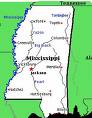
*Dane and Dave were eager to go to Mississippi, just a few minutes away from Memphis, although they had very different reasons. =Dane wanted to cross Mississippi off his state list. He now has been to every state but Alaska, Hawaii, Vermont, Texas, New Mexico and Oregon. Rick and Dave were just as impressed as you are. =Dave, the same man that calls his mother every day and uses the parking brakes every single time he parks the car just like they taught him in Driver’s Ed, is actually a maniacal gambler, and knew that Mississippi has casinos.
*Rick and Dane walked around the casino looking at gamblers. Not one smile in the entire casino. Dave was one of the “happy” gamblers, sitting at the $5 blackjack table. Only the smallest bladder on the planet (or possibly an enlarged prostate) prevented him from remaining there to this day.
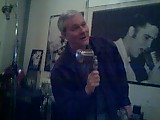
*While Rick attended his conference the following day, Dane & Dave went to Sun Studios and took the very cool tour there. That's Dane on the left standing in the exact spot Elvis recorded “That’s Alright Mama.” That's Dave on the right, proudly singing about getting the AAA discount even though his card had expired.
*At the media conference, Rick grabbed some lunch at Quiznos. To give you an idea what kind of a crowd attended this conference, the three people in front of Rick… =complained about the absence of romaine lettuce on the sandwiches. =lectured the teenager behind the counter that the “roast chicken” sandwich should be called the “tortured chicken sandwich” AND last but not least… =demanded to know why “vitamin water” was not available as a fountain drink. Rick ordered the Italian with everything. The teenager behind the counter smiled.
*Rick got home from the conference just in time to break up the fight between Dane and Dave. Dane wanted to go to the Cotton Museum. Dave said he would rather be poked in the eyes by Liza Minnelli.
*That night we explored Beale Street, the party center of Memphis. After an incredible BBQ dinner, we settled in at a blues bar. After one of Dave’s three trips to the bathroom, he claimed to have spotted Dennis Quaid. Rick and Dane would have been much more impressed by Randy Quaid.
*Next stop: Pat O’Briens. The Memphis version of the famous New Orleans nightspot is almost an exact duplicate of the original. A rock and roll cover band was playing Van Halen in the courtyard. Rick and Dave wandered out to listen. Dane yelled “This is too loud!” and went to the dueling piano bar to listen to the Billy Joel medley instead.
*After a night of drinking, we stopped in for a late night burger. After we ordered the burgers, Dane noticed they weren’t being made on a grill. They were being boiled in a vat of animal fat. Mmmm.
*The night came to end when Dave’s “throbbing headache” had to be relieved with a medication cocktail that included Tylenol and Ambien.
*The following morning, the three middle aged travelers went to Graceland, where we suddenly didn’t feel so old.
*Dave got a little cocky at Graceland. He tried to get the student discount with his University of Illinois student ID card from 1985. “1985 Dave” had a full head of hair. “2007 Dave” has a gray goatee, and a shiny polished dome. The cashier didn’t go for it. This is her reaction when we tried to take her picture.
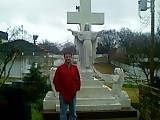
*Rick was grumbling that there weren’t any new Graceland snow domes since his last visit, so he bought an Elvis/Nixon magnet instead. This is the geek by Elvis’ grave.
*Lunch at Corky’s was the best meal of the trip…an unbelievable BBQ pork meal. Dave went to the bathroom there twice. Dane told Dave that he would make a provision in his will donating his bladder to Dave.
*After lunch, Rick and Dave took a nap. Dane went to the Cotton Museum by himself. If you ever meet him, ask to see the video. He videotaped the experience on his cell-phone, but we couldn't figure out how to upload it here.
*Not wanting to go out drinking again, the boys settled on an excursion to Arkansas for their last night. It wasn’t until they arrived at the dog track that Dane & Rick realized why Dave was so excited about this…it was attached to a casino.
*If you ever feel like you are at the lowest point in your life, remember this: You haven’t hit rock bottom until you spend a Saturday night at a dog track in Arkansas.
*Although...the bar was serving 20 ounce Michelob beers for 50 cents a piece. Rick had three dollars in his pocket and a song in his heart.
*Dane picked the winners of the first two dog races. After that, not so much. This is Dane tearing up his betting slips.
*Dave got in a poker game, and was one $250 pot away from losing everything. When he didn’t lose the hand, he got out, and didn’t return. Although, he did stop at the video poker machines on his way back from his second bathroom trip.
*The night ended when Rick got heartburn. He bought Pepto Bismol in the hotel gift shop…at the nicer hotel next door.
*The next morning when we checked out of the hotel, Dave asked the clerk to name the most famous person who ever stayed at their hotel. She said: “The tall guy from the TV show ‘Martin’ had his family reunion here.” Top that.
*The next day the middle aged travelers arrived at the airport two and a half hours before their flight so they could watch the Bears-Seahawks playoff game.
*With fifty seconds left in the tied game, the airline announced… “Chicago fans, this is your last call for boarding. We’re going to give away your tickets if you don’t board right now.” An audible groan went up in the airport bar. We walked down the tunnel toward the airplane not knowing if the game went to overtime or not. Dave, Dane and Rick tried to convince everyone to draw straws to see who would fake a heart attack in the tunnel to delay the flight.
*The flight attendant was British. She announced the football game result this way: “I’m not sure what this means, but the team from Chicago…I’m told they are known as the Bears…scored… is it called a field goal? Yes. In any case, they won the American football contest.” We cheered, but we suddenly all felt stupid for caring.
So, was our middle aged road trip fun? I know it might not sound like it, but we had a great time. Will we do it again? Probably.
*This week in 1932, William Wrigley died. Cub fans had no idea that moment would usher in a 45-year period of darkness. I wrote about it in EveryCubEver, but also for Justonebadcentury.com
*Ellen Degeneres is celebrating a birthday this week. My memorable brush with her during my Loop years didn't make the final version of The Loop Files, but I did write about it here.