The Cubs are going to the circus.
The baseball circus, that is: The Miami Marlins. It's Ozzie's first game after his suspension. It's Carlos Zambrano's first time facing the Cubs after quitting on them last year.
You'll have to watch the game to find out who wins, because the reporting tomorrow will barely mention it.
Musings, observations, and written works from the publisher of Eckhartz Press, the media critic for the Illinois Entertainer, co-host of Minutia Men, Minutia Men Celebrity Interview and Free Kicks, and the author of "The Loop Files", "Back in the D.D.R", "EveryCubEver", "The Living Wills", "$everance," "Father Knows Nothing," "The Radio Producer's Handbook," "Records Truly Is My Middle Name", and "Gruen Weiss Vor".
Tuesday, April 17, 2012
Monday, April 16, 2012
Cubs 365, April 16
On this day in 1972, Cubs rookie Burt Hooten threw a no-hitter in only his fourth big league start. He walked seven and struck out seven Phillies on a cold and blustery Wrigley afternoon, throwing 120 pitches.
The Philadelphia lineup was no pushover. Among the good hitters on that team: Larry Bowa, Willie Montanez, Deron Johnson, Greg Luzinski, Don Money and Tim McCarver. The only time Hooten was even remotely in trouble was in the top of the 7th inning. He walked both Don Money and outfielder Mike Anderson before striking out Denny Doyle to end the inning.
Like another future Cubs rookie phenom from Texas, Hooten had a flair for the dramatic. He struck out the last two hitters he faced; Deron Johnson and Greg Luzinski. It was undoubtedly the highlight of his Cubs career.
Unfortunately, Hooten was traded away just a few years later to the Los Angeles Dodgers. The players the Cubs got in return, Eddie Soloman and Geoff Zahn, had no impact whatsoever in Chicago. Hooten, on the other hand, would go on to win at least 10 games eight years in a row for the Dodgers (including two seasons with 18, and another with 19), and would pitch in three World Series.
The Philadelphia lineup was no pushover. Among the good hitters on that team: Larry Bowa, Willie Montanez, Deron Johnson, Greg Luzinski, Don Money and Tim McCarver. The only time Hooten was even remotely in trouble was in the top of the 7th inning. He walked both Don Money and outfielder Mike Anderson before striking out Denny Doyle to end the inning.
Like another future Cubs rookie phenom from Texas, Hooten had a flair for the dramatic. He struck out the last two hitters he faced; Deron Johnson and Greg Luzinski. It was undoubtedly the highlight of his Cubs career.
Unfortunately, Hooten was traded away just a few years later to the Los Angeles Dodgers. The players the Cubs got in return, Eddie Soloman and Geoff Zahn, had no impact whatsoever in Chicago. Hooten, on the other hand, would go on to win at least 10 games eight years in a row for the Dodgers (including two seasons with 18, and another with 19), and would pitch in three World Series.
Rick and Brendan on the Internet
Metrolingua Blogger Margaret Larkin interviewed us about our book "The Living Wills".
You can read it here.
Sunday, April 15, 2012
Father Knows Nothing
This week's Father Knows Nothing has been posted. It's about the most ridiculous argument ever.
You can read it here.
Cubs 365, April 15
On this day in 1886, future Cubs pitcher King Cole was born.
His real name was Leonard Leslie Cole. He started his baseball career as a pitcher with the Cubs in 1909. By 1910, he was the ace of the staff. He led the National League that season with a record of 20-4 and helped win a National League Pennant for the Cubs. His 20-4 record is the best winning percentage (.866) for a Cubs pitcher in the twentieth Century.
He was immortalized as "King" Cole by Ring Lardner, who no doubt, got it from the children's nursery rhyme 'Old King Cole.' King Cole didn't stay with the Cubs very long. He won 18 games for them in 1911, and was traded (along with fan favorite Solly Hofman) to the Pirates for Tommy Leach early in the 1912 season.
He later landed in the American League, where Cole gave up Babe Ruth's first ever hit in the majors (a double on October 2, 1914). But this King Cole would not live to be a merry old soul. In 1915, he contracted a disease that knocked him out of baseball. Some sources say it was malaria, others say tuberculosis, and still others speculate it was syphilis, but whatever the disease, it took Cole's life.
He died on January 6th, 1916, a few months shy of his 30th birthday
His real name was Leonard Leslie Cole. He started his baseball career as a pitcher with the Cubs in 1909. By 1910, he was the ace of the staff. He led the National League that season with a record of 20-4 and helped win a National League Pennant for the Cubs. His 20-4 record is the best winning percentage (.866) for a Cubs pitcher in the twentieth Century.
He was immortalized as "King" Cole by Ring Lardner, who no doubt, got it from the children's nursery rhyme 'Old King Cole.' King Cole didn't stay with the Cubs very long. He won 18 games for them in 1911, and was traded (along with fan favorite Solly Hofman) to the Pirates for Tommy Leach early in the 1912 season.
He later landed in the American League, where Cole gave up Babe Ruth's first ever hit in the majors (a double on October 2, 1914). But this King Cole would not live to be a merry old soul. In 1915, he contracted a disease that knocked him out of baseball. Some sources say it was malaria, others say tuberculosis, and still others speculate it was syphilis, but whatever the disease, it took Cole's life.
He died on January 6th, 1916, a few months shy of his 30th birthday
Saturday, April 14, 2012
Chicago Radio Spotlight: Greg Bell
This weekend's Chicago Radio Spotlight has been posted. I interviewed the host of "When Radio Was", which airs locally here on WBBM-AM 780.
You can read it here.
Cubs 365, April 14
On this day in 1970, the Cubs won their home opener against the Philadelphia Phillies. No one remembers that it was the first game in Cubs uniform for Johnny Callison. Or that one of the players he was traded for, Dick Selma, pitched in relief and got pounded by the Cubs.
That game is remembered most for the out of control crowd that day. There were so many fights in the stands, the Cubs instituted new security measures. Among them, installing the screen at the top of the wall--to keep the fans from coming onto the field.
Before that was put up, drunken fans tried to tightrope the walls -- and, depending on their alcohol consumption, had a tendency to fall...hard. The reason the baskets are still up is that they have been incredibly successful at achieving their main goal: keeping inebriated fans from falling onto the playing field.
Despite what former ESPN commentator Joe Morgan has said, putting up that screen had absolutely nothing to do with getting more "cheap home runs" for Ernie Banks. Ernie only played one of his 18 Cubs seasons with the screen in place. Joe Morgan should know better.
That game is remembered most for the out of control crowd that day. There were so many fights in the stands, the Cubs instituted new security measures. Among them, installing the screen at the top of the wall--to keep the fans from coming onto the field.
Before that was put up, drunken fans tried to tightrope the walls -- and, depending on their alcohol consumption, had a tendency to fall...hard. The reason the baskets are still up is that they have been incredibly successful at achieving their main goal: keeping inebriated fans from falling onto the playing field.
Despite what former ESPN commentator Joe Morgan has said, putting up that screen had absolutely nothing to do with getting more "cheap home runs" for Ernie Banks. Ernie only played one of his 18 Cubs seasons with the screen in place. Joe Morgan should know better.
Friday, April 13, 2012
Coming this weekend
Chicago Radio Spotlight returns tomorrow. I interviewed Greg Bell, the host of "When Radio Was", which airs locally on WBBM-AM 780.
On Sunday, a new Father Knows Nothing column will be about one of the most ridiculous arguments my boys have ever had (and they've had some doozies).
Also, as usual, the Just One Bad Century website will go back to this week in 1908 and 1945, and the Just One Bad Century blog will have a story about April 14 and April 15 in Cubs history as part of Cubs 365.
Have a great weekend!
On Sunday, a new Father Knows Nothing column will be about one of the most ridiculous arguments my boys have ever had (and they've had some doozies).
Also, as usual, the Just One Bad Century website will go back to this week in 1908 and 1945, and the Just One Bad Century blog will have a story about April 14 and April 15 in Cubs history as part of Cubs 365.
Have a great weekend!
Cubs 365, April 13
On this day in 1992, the Cubs were in Pittsburgh, while their home city of Chicago was undergoing one of the strangest events in it's colorful history.
250 million gallons of water were flooding the basements of Loop office buildings and retail stores because workers doing rehabilitation work on the Kinzie Street Bridge crossing the Chicago River didn't know about an abandoned tunnel beneath the river, and drove a pylon into the tunnel wall. The city had to evacuate the area because they feared electrical wires would short out. Trading at both the Chicago Board of Trade Building and the Chicago Mercantile Exchange was stopped.
Workers attempted to plug the hole, by then about 20 feet wide, with 65 truckloads of rocks, cement, and mattresses. That odd vision of mattresses being thrown into the river is one that Chicagoans won't soon forget.
That Cubs team, however, was pretty forgettable.
While the city flooded, the Cubs got swept by eventual division champion Pittsburgh. Batting second for the Cubs and playing centerfield was a young player the Cubs had gotten from the Chicago White Sox in spring training—-Sammy Sosa.
Unfortunately for Sammy, his first Cubs season was a painful one. He missed most of June and July with a broken finger, and then returned only to break his ankle on August 6th. He missed the rest of the year.
At the time, the Sammy trade was considered so terrible by Cubs fans, that they speculated Cubs GM Larry Himes (a former White Sox GM) was actually a White Sox spy sent to infiltrate the Cubs organization. The player the Cubs traded away to get Sammy, George Bell, had a few very good years on the South Side while Sammy was struggling mightily on the North Side.
Those theories quickly vanished after Sammy hit 500+ home runs for the Cubs.
250 million gallons of water were flooding the basements of Loop office buildings and retail stores because workers doing rehabilitation work on the Kinzie Street Bridge crossing the Chicago River didn't know about an abandoned tunnel beneath the river, and drove a pylon into the tunnel wall. The city had to evacuate the area because they feared electrical wires would short out. Trading at both the Chicago Board of Trade Building and the Chicago Mercantile Exchange was stopped.
Workers attempted to plug the hole, by then about 20 feet wide, with 65 truckloads of rocks, cement, and mattresses. That odd vision of mattresses being thrown into the river is one that Chicagoans won't soon forget.
That Cubs team, however, was pretty forgettable.
While the city flooded, the Cubs got swept by eventual division champion Pittsburgh. Batting second for the Cubs and playing centerfield was a young player the Cubs had gotten from the Chicago White Sox in spring training—-Sammy Sosa.
Unfortunately for Sammy, his first Cubs season was a painful one. He missed most of June and July with a broken finger, and then returned only to break his ankle on August 6th. He missed the rest of the year.
At the time, the Sammy trade was considered so terrible by Cubs fans, that they speculated Cubs GM Larry Himes (a former White Sox GM) was actually a White Sox spy sent to infiltrate the Cubs organization. The player the Cubs traded away to get Sammy, George Bell, had a few very good years on the South Side while Sammy was struggling mightily on the North Side.
Those theories quickly vanished after Sammy hit 500+ home runs for the Cubs.
Thursday, April 12, 2012
I Love Rock and Roll
#1 on this day in 1982, exactly 30 years ago...
Don't Call Me April 27, May 2, or May 18
This week's Suburban Dad contribution to the City Mom blog has been posted.
It's about our insane schedule.
Cubs 365, April 12
On April 12, 1933, the Wrigley Field crowd was undoubtedly happier than it has been since 1919. This was the first game at Wrigley Field since Prohibition had been repealed, although it would be another month before beer was officially available again.
The Cubs were the defending NL Champs, and the crowd of 25,000 witnessed a great pitching performance by Cubs ace Lon Warneke. He out-dueled the best pitcher in baseball, Dizzy Dean, throwing a 4-hit shutout against a Cardinals lineup that featured future Hall of Famers Joe Medwick and Frankie Frisch.
Warneke's battery-mate Gabby Hartnett was the hitting star for the Cubs that day. He got three hits, and knocked in two runs, as the Cubs won the game 3-0.
Neither the Cubs nor the Cardinals ended the season in first place in 1933. The National League pennant went to the New York Giants. They went on to beat the Washington Senators in the World Series.
The Cubs were the defending NL Champs, and the crowd of 25,000 witnessed a great pitching performance by Cubs ace Lon Warneke. He out-dueled the best pitcher in baseball, Dizzy Dean, throwing a 4-hit shutout against a Cardinals lineup that featured future Hall of Famers Joe Medwick and Frankie Frisch.
Warneke's battery-mate Gabby Hartnett was the hitting star for the Cubs that day. He got three hits, and knocked in two runs, as the Cubs won the game 3-0.
Neither the Cubs nor the Cardinals ended the season in first place in 1933. The National League pennant went to the New York Giants. They went on to beat the Washington Senators in the World Series.
Craig's List Post Seeks Bullpen Help for Cubs
This is pretty funny. CBS Chicago has all the details.
It's the handiwork of Jonathan Eig, one of the people that contributed to "Cubbie Blues: 100 Years of Waiting 'Til Next Year".
Not quite as funny as our birth announcement a few years ago ("Waitle Nex Yeare"), but that may just be envy talking...I can't believe JOBC didn't think of this first.
It's the handiwork of Jonathan Eig, one of the people that contributed to "Cubbie Blues: 100 Years of Waiting 'Til Next Year".
Not quite as funny as our birth announcement a few years ago ("Waitle Nex Yeare"), but that may just be envy talking...I can't believe JOBC didn't think of this first.
Wednesday, April 11, 2012
"The Living Wills" on the radio
A week or two ago I was on the Steve Cochran show discussing my book "The Living Wills", my new publishing company Eckhartz Press, and a few other things.
They sent me the audio, in case you missed it.
Here it is.
I always enjoy being on Steve's show. He's great at making his guests feel comfortable, and he can make any discussion entertaining.
They sent me the audio, in case you missed it.
Here it is.
I always enjoy being on Steve's show. He's great at making his guests feel comfortable, and he can make any discussion entertaining.
Cubs 365, April 11
On this day in 1955, Opening Day at Crosley Field in Cincinnati, Sam Jones made history for the Cubs. He became the first African American pitcher to ever wear a Cubs uniform.
Jones came into the game in relief of Cubs starter Bob Rush in the fourth inning, with the Cubs clinging to a 6-4 lead. All Jones did was pitch five innings of one-run ball. He struck out five Reds batters during that five inning stint before giving way to Jeffcoat with two outs in the 9th. One out later, Jones also became the first African American pitcher to win a game for the Cubs when Jeffcoat induced Wally Post to hit into a fielder's choice to end the game.
Drinking and Driving
This comes via e-mail. Thanks to "MS" for sending it...
Seeing as my days of drinking are LONG gone and my days of DRIVING have been taken away from me recently, I'd like to share an experience with you about them both.
As you well know, some of us have been known to have had brushes with the authorities, on our way home from a "social session" over the years. A couple of years ago, I was out for a few drinks with some friends at the one of our local pubs and had some rather nice Scotch Whiskey.
Knowing full well I may have been slightly over the limit, I did something I've never done before: I took a bus home. Sure enough I passed a police road block but as it was a bus, they waved it past. I arrived home safely without incident, which was a real surprise, as I have never driven a bus before and am not sure where I got it.
Tuesday, April 10, 2012
We Can Wait 100 Years (2012)
Here's the updated version of the song Brandmeier asked us to perform on the air last week: We Can Wait 100 Years (2012)
It should be good for another few years.
Cubs 365, April 10
On this day in 1921, future Cubs first baseman Chuck Connors was born.
The physically imposing 6'5" Connors played first base for the Cubs in 1951 and hit a whopping two home runs in 200 at bats, not exactly the kind of power you want from a big first baseman. That performance earned him a trip back to the minors.
Luckily for him, the Cubs minor league team at the time was in Los Angeles. While he was playing in the Cubs minor league system he got a bit part in the movie "Pat & Mike" (starring Spencer Tracy--1952). That led him to quit baseball for good and become a full-time actor. By 1958, he was starring in "The Rifleman," which aired until 1963. He also starred in Old Yeller, Soylent Green, and Roots, and is arguably the greatest Cubs actor of all-time (other than Sammy Sosa during his "corked bat" press conference).
The physically imposing 6'5" Connors played first base for the Cubs in 1951 and hit a whopping two home runs in 200 at bats, not exactly the kind of power you want from a big first baseman. That performance earned him a trip back to the minors.
Luckily for him, the Cubs minor league team at the time was in Los Angeles. While he was playing in the Cubs minor league system he got a bit part in the movie "Pat & Mike" (starring Spencer Tracy--1952). That led him to quit baseball for good and become a full-time actor. By 1958, he was starring in "The Rifleman," which aired until 1963. He also starred in Old Yeller, Soylent Green, and Roots, and is arguably the greatest Cubs actor of all-time (other than Sammy Sosa during his "corked bat" press conference).
Monday, April 09, 2012
Cubs 365, April 9
On this day in 1888, one of the greatest pitchers in Cubs history was born. His name was Hippo Vaughn.
Hippo Vaughn got his nickname because of his size (he was about the same size as Rick Reuschel). He was the star of the 1918 pennant winners (won the pitching triple crown that year). The 1919 Black Sox may have believed that the 1918 Cubs threw that World Series, but if they did, no one suspected Hippo Vaughn was part of it. He started three games in that series, and although he was only 1-2, his ERA was 1.00 and he struck out 17 batters.
Hippo won the ERA title the following year too, and was a 20-game winner 5 times, a 19-game winner once and a 17-game winner another time in his nine seasons with the Cubs. During the years 1914-1920 he was one of the best pitchers in the entire National League.
Hippo's career ended in 1921 when manager Johnny Evers suspended him for thirty days for insubordination. In 1922, he got into a salary dispute, and chose to pitch for a semi-pro team instead. He was reinstated by Commissioner Landis after 8 years of ineligibility in 1930. He went to spring training with the Cubs in 1931 but failed to make the team at age 43.
Hippo Vaughn got his nickname because of his size (he was about the same size as Rick Reuschel). He was the star of the 1918 pennant winners (won the pitching triple crown that year). The 1919 Black Sox may have believed that the 1918 Cubs threw that World Series, but if they did, no one suspected Hippo Vaughn was part of it. He started three games in that series, and although he was only 1-2, his ERA was 1.00 and he struck out 17 batters.
Hippo won the ERA title the following year too, and was a 20-game winner 5 times, a 19-game winner once and a 17-game winner another time in his nine seasons with the Cubs. During the years 1914-1920 he was one of the best pitchers in the entire National League.
Hippo's career ended in 1921 when manager Johnny Evers suspended him for thirty days for insubordination. In 1922, he got into a salary dispute, and chose to pitch for a semi-pro team instead. He was reinstated by Commissioner Landis after 8 years of ineligibility in 1930. He went to spring training with the Cubs in 1931 but failed to make the team at age 43.
Friday, April 06, 2012
Easter Weekend
May your Easter weekend be as fabulous as my dog Ivy's daily life. Lots of eating, sleeping, lounging, and running around the backyard protecting people from imaginary intruders.
Should the Cubs get public money to renovate Wrigley?
I was quoted in this AP article about the Cubs attempting to get public funding from the city of Chicago to repair Wrigley Field.
Cubs 365, April 6
On April 6, 1973, the Cubs won the opener 3-2 over the Expos in the bottom of the ninth, after the best relief pitcher in baseball, Mike Marshall, walked in two runs.
Ferguson Jenkins was the starting pitcher for the Cubs that day, and pitched a great game. He only gave up 5 hits and 2 runs, but didn't factor in the decision. It would be a microcosm of his 1973 season, his last with the Cubs. Fergie would fail to win 20 games for the Cubs that year for the first time since 1966. In the offseason he was shipped to Texas for Bill Madlock.
The winning run in this game, by the way, was historic. It was scored by a pinch runner named Tony LaRussa, in his only game as a Cub.
Ferguson Jenkins was the starting pitcher for the Cubs that day, and pitched a great game. He only gave up 5 hits and 2 runs, but didn't factor in the decision. It would be a microcosm of his 1973 season, his last with the Cubs. Fergie would fail to win 20 games for the Cubs that year for the first time since 1966. In the offseason he was shipped to Texas for Bill Madlock.
The winning run in this game, by the way, was historic. It was scored by a pinch runner named Tony LaRussa, in his only game as a Cub.
Opening Day at Wrigley with Johnny B
I was there taking photos and lending moral support to Tom Latourette, the man who sang the song I wrote called "We Can Wait One Hundred Years". He sang it live on the air with Tom Ricketts standing five feet away.
You can listen to that here, by the way. It's a little less than half way through this 7:00 Am hour.
Here are a few photos from the show...
From left to right, Steve Bertrand, Dave Eanet, and Jonathon Brandmeier
Johnny B interviews Cubs broadcaster Keith Moreland
Tom Latourette sings "We Can Wait 100 Years" live on the air. If you click on the picture to enlarge it, look at the audience in front of him. That's Tom Ricketts on the far right.
At one point of the song, Johnny B actually got behind the drums and drummed along.
Tom Ricketts with Tom Latourette
Johnny B and Tom Ricketts
The winners of the Cubs song contest, The Fold, along with the host of the festivities this morning, Jonathon Brandmeier.
You can listen to that here, by the way. It's a little less than half way through this 7:00 Am hour.
Here are a few photos from the show...
From left to right, Steve Bertrand, Dave Eanet, and Jonathon Brandmeier
Johnny B interviews Cubs broadcaster Keith Moreland
Tom Latourette sings "We Can Wait 100 Years" live on the air. If you click on the picture to enlarge it, look at the audience in front of him. That's Tom Ricketts on the far right.
At one point of the song, Johnny B actually got behind the drums and drummed along.
Tom Ricketts with Tom Latourette
Johnny B and Tom Ricketts
The winners of the Cubs song contest, The Fold, along with the host of the festivities this morning, Jonathon Brandmeier.
Thursday, April 05, 2012
Wednesday, April 04, 2012
A Programming Note
Four years ago when I created my website Just One Bad Century, I also wrote a song to fire up the troops. It was called "We can wait 100 years" and it was a parody of the Proclaimer's hit "I Can Walk 500 Miles".
It got a bunch of airplay on Chicago radio that season: John Landecker played it on WLS, and Johnny B played it on the Loop.
Well this year Brandmeier started playing it on his show again (he's now on WGN) when he was hyping the Cubs song contest. He mentioned on the air that he wished we would update the song for him, because it mentions people no longer around (Lou Piniella and Kosuke Fukodome).
So, I rewrote the words, and the guy that sings it, Tom Latourette, went into the studio to re-record it. (I'll be posting the new version on the website soon.)
In the meantime, you can hear it live on WGN radio tomorrow morning at 8:00. Tom will be singing it live on Johnny B's remote broadcast from outside Wrigley Field. I'll be on hand to lend moral support. Please tune in--it should be fun.
Here's the original song for those of you that don't remember it...
It got a bunch of airplay on Chicago radio that season: John Landecker played it on WLS, and Johnny B played it on the Loop.
Well this year Brandmeier started playing it on his show again (he's now on WGN) when he was hyping the Cubs song contest. He mentioned on the air that he wished we would update the song for him, because it mentions people no longer around (Lou Piniella and Kosuke Fukodome).
So, I rewrote the words, and the guy that sings it, Tom Latourette, went into the studio to re-record it. (I'll be posting the new version on the website soon.)
In the meantime, you can hear it live on WGN radio tomorrow morning at 8:00. Tom will be singing it live on Johnny B's remote broadcast from outside Wrigley Field. I'll be on hand to lend moral support. Please tune in--it should be fun.
Here's the original song for those of you that don't remember it...
Cubs 365, April 4
On this day in 1994, the Cubs had a memorable home opener against the New York Mets. A little known player named Tuffy Rhodes hit three homers that day to power the Cubs to a victory.
Cubs fans had delusions of grandeur after that game, but Tuffy hit only five more homers the rest of the season. 1994 was also the year that Major League Baseball cancelled the World Series because the players were on strike. Not that the Cubs would have had a shot at winning it. When the league shut it down for the year in August, the Cubs were 15 games under .500 and 16 1/2 games out of first place.
Tuffy left the Cubs the following season. He eventually played in Japan, where he finally realized his full potential. In 2001 he tied the Japanese League record for most home runs in a season, a record held by the immortal Sadaharu Oh since 1964. Tuffy easily could have broken the record, but after he tied Oh, Japanese pitchers intentionally walked him the rest of the year.
Cubs fans had delusions of grandeur after that game, but Tuffy hit only five more homers the rest of the season. 1994 was also the year that Major League Baseball cancelled the World Series because the players were on strike. Not that the Cubs would have had a shot at winning it. When the league shut it down for the year in August, the Cubs were 15 games under .500 and 16 1/2 games out of first place.
Tuffy left the Cubs the following season. He eventually played in Japan, where he finally realized his full potential. In 2001 he tied the Japanese League record for most home runs in a season, a record held by the immortal Sadaharu Oh since 1964. Tuffy easily could have broken the record, but after he tied Oh, Japanese pitchers intentionally walked him the rest of the year.
Can't Get it Out of my Head
Ever since Mad Men aired the other night, I haven't been able to get this song out of my head. And then, this morning, while I was driving my son Johnny to school, Brandmeier had the original singer of the song on the air. Now I fear this one is stuck for awhile...
Here's the original...
Labels:
video vault
Tuesday, April 03, 2012
Cubs 365, April 3
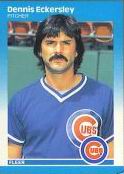
On this day in 1987, the Cubs traded away their disappointing starting pitcher Dennis Eckersley to the Oakland As for three minor leaguers: Brian Guinn, Dave Wilder, and Mark Leonette.
Eckersley was coming off a 6-11 1986 season, and the Cubs brass believed that he was essentially done at 32 years old.
Needless to say, this trade didn't work out that well for the Cubs. The three players they acquired for him never made it to the big leagues, while Eckersley was moved to the bullpen by the A's and proceeded to save 390 games. He pitched another 12 years, and in five of those years he was an All-Star.
He also won a Cy Young, an MVP Award, a World Series, and a place in baseball's Hall of Fame.
Eckersley was coming off a 6-11 1986 season, and the Cubs brass believed that he was essentially done at 32 years old.
Needless to say, this trade didn't work out that well for the Cubs. The three players they acquired for him never made it to the big leagues, while Eckersley was moved to the bullpen by the A's and proceeded to save 390 games. He pitched another 12 years, and in five of those years he was an All-Star.
He also won a Cy Young, an MVP Award, a World Series, and a place in baseball's Hall of Fame.
Monday, April 02, 2012
Cubs 365, April 2
On April 2, 1917, less than one month after beginning his second term in office, President Woodrow Wilson asked Congress to declare war on Germany to keep the world “safe for democracy.” Congress obliged.
The war didn't immediately affect the national pastime. At first the American public rallied around the flag, and enlistment in the Army was robust. The Cubs did their part too. They booked a demonstration at Wrigley by Canadian Highlanders to encourage recruiting. Recruiting booths were set up around the ballpark to facilitate the process.
The following season was a different story. Gruesome stories from the war started coming home, and people no longer wanted to enlist, so it became compulsory. Even though the Cubs were heading toward the NL Pennant, attendance hit an all-time low. That may have had something to do with the military's presence in the ballpark. By then Wrigley Field (still known as Cubs Park) had become a dangerous place for "slackers" (men who hadn't yet registered for military service).
They weren't just checking tickets at the gate, federal agents were standing by to check registration cards to make sure there were no draft dodgers attending the games. Anyone of draft age who didn't have a card was held for investigation. Scores of fans were led directly to military bases and inducted into the service.
It's funny how much that'll put a crimp into your box office receipts.
The war didn't immediately affect the national pastime. At first the American public rallied around the flag, and enlistment in the Army was robust. The Cubs did their part too. They booked a demonstration at Wrigley by Canadian Highlanders to encourage recruiting. Recruiting booths were set up around the ballpark to facilitate the process.
The following season was a different story. Gruesome stories from the war started coming home, and people no longer wanted to enlist, so it became compulsory. Even though the Cubs were heading toward the NL Pennant, attendance hit an all-time low. That may have had something to do with the military's presence in the ballpark. By then Wrigley Field (still known as Cubs Park) had become a dangerous place for "slackers" (men who hadn't yet registered for military service).
They weren't just checking tickets at the gate, federal agents were standing by to check registration cards to make sure there were no draft dodgers attending the games. Anyone of draft age who didn't have a card was held for investigation. Scores of fans were led directly to military bases and inducted into the service.
It's funny how much that'll put a crimp into your box office receipts.
Sunday, April 01, 2012
Father Knows Nothing
I just posted my latest "Father Knows Nothing" column at NWI Parent. This one is called "Mark Twained" and it's about my attempt at exposing my youngest son to a classic of American literature
You can read it here.
Cubs 365, April 1
On this day in 1978, the final "Bob Newhart Show" episode aired on CBS. The show was set in Chicago.
Bob, of course, was a Chicago native and a life long Cubs fan. He doesn't get back to town very often, but the last time he did, he told the Tribune there was a special location he was definitely going to visit: "While I'm downtown, I also want to get over to LaSalle Street where in 1945 I stood as we welcomed back the victorious Chicago Cubs for winning the National League pennant. I guess that was the last time we did that."
Bob furthered showed his Cub colors in his television show. It featured an entire episode about a forlorn Cubs pitcher. You can watch that episode on Hulu.
Bob may be living in LA now, but his favorite color blue is definitely not Dodger Blue.
Bob, of course, was a Chicago native and a life long Cubs fan. He doesn't get back to town very often, but the last time he did, he told the Tribune there was a special location he was definitely going to visit: "While I'm downtown, I also want to get over to LaSalle Street where in 1945 I stood as we welcomed back the victorious Chicago Cubs for winning the National League pennant. I guess that was the last time we did that."
Bob furthered showed his Cub colors in his television show. It featured an entire episode about a forlorn Cubs pitcher. You can watch that episode on Hulu.
Bob may be living in LA now, but his favorite color blue is definitely not Dodger Blue.
Saturday, March 31, 2012
Chicago Radio Spotlight: Pugs Moran
This week's Chicago Radio Spotlight interview is with a native Chicagoan who got his start here in his hometown, but has been down in Dallas for the last ten years. His name is Pugs Moran.
You can read it here.
Cubs 365, March 31
Every day in 2012, the Just One Bad Century blog will feature a story about this day in Cubs history. We're calling it Cubs 365.
On this day in 1961, the Cubs traded Moe Drabowsky to the Milwaukee Braves. Moe should have been a star in Chicago. He had it all; a live arm, a great personality, and a birth certificate that proved he was born in Poland. In a city with the biggest Polish population outside of Warsaw, Drabowsky could have been a legend.
Unfortunately, he never quite put it together on the mound. He won 13 games for the Cubs in 1957, and then won only another 17 games the next three seasons combined. After playing in Milwaukee a year, and then bouncing around to Cincinnati and Kansas City, Moe landed in Baltimore.
At the age of 30, Moe finally blossomed. The Orioles moved him to the bullpen, and he became a key part of their World Champion teams in 1966 & 1970.
On this day in 1961, the Cubs traded Moe Drabowsky to the Milwaukee Braves. Moe should have been a star in Chicago. He had it all; a live arm, a great personality, and a birth certificate that proved he was born in Poland. In a city with the biggest Polish population outside of Warsaw, Drabowsky could have been a legend.
Unfortunately, he never quite put it together on the mound. He won 13 games for the Cubs in 1957, and then won only another 17 games the next three seasons combined. After playing in Milwaukee a year, and then bouncing around to Cincinnati and Kansas City, Moe landed in Baltimore.
At the age of 30, Moe finally blossomed. The Orioles moved him to the bullpen, and he became a key part of their World Champion teams in 1966 & 1970.
Friday, March 30, 2012
Coming this weekend
Tomorrow morning I'll be posting a new Chicago Radio Spotlight interview. This week's interview subject is former Kevin Matthews and Bill & Wendy producer Pugs Moran--now a radio star in Dallas.
A new Father Knows Nothing column on Sunday will tell the tale of a dad trying to educate his youngsters with classic literature...only to terrify the bejesus out of them instead.
There will also be two new Cubs 365 stories, and the Just One Bad Century website will go back in time to this week in 1908 and 1945.
Have a great weekend!
A new Father Knows Nothing column on Sunday will tell the tale of a dad trying to educate his youngsters with classic literature...only to terrify the bejesus out of them instead.
There will also be two new Cubs 365 stories, and the Just One Bad Century website will go back in time to this week in 1908 and 1945.
Have a great weekend!
Cubs 365, March 30
Every day in 2012, the Just One Bad Century blog will feature a story about this day in Cubs history. We're calling it Cubs 365.
On this day in 1904, future Cub Ripper Collins was born. If his name sounds familiar, it should. He was mentioned in Cubs 365 just the other day as the man the Cubs acquired when they shipped off their best pitcher Lon Warneke in 1937.
His real name was James Anthony Collins, but everyone called him "Rip" or "Ripper." He said he got his nickname when, as a boy, he hit the team's only ball and snagged it on a fence nail, ripping its cover.
Collins was a star with the Cardinals, and to be fair, he got off to a good start with the Cubs too. Ripper was an all-star for the Cubs in '37, and played on the pennant winner in 1938, but he hit only .133 in the Series, and with Phil Cavarretta on the team, Collins was no longer wanted or needed.
The Cubs released him before the 1939 season…on his 35th birthday.
On this day in 1904, future Cub Ripper Collins was born. If his name sounds familiar, it should. He was mentioned in Cubs 365 just the other day as the man the Cubs acquired when they shipped off their best pitcher Lon Warneke in 1937.
His real name was James Anthony Collins, but everyone called him "Rip" or "Ripper." He said he got his nickname when, as a boy, he hit the team's only ball and snagged it on a fence nail, ripping its cover.
Collins was a star with the Cardinals, and to be fair, he got off to a good start with the Cubs too. Ripper was an all-star for the Cubs in '37, and played on the pennant winner in 1938, but he hit only .133 in the Series, and with Phil Cavarretta on the team, Collins was no longer wanted or needed.
The Cubs released him before the 1939 season…on his 35th birthday.
Thursday, March 29, 2012
Cubs 365, March 29
Every day in 2012, the Just One Bad Century blog will feature a story about this day in Cubs history. We're calling it Cubs 365.
On this day in 1954, one of the greatest Cubs of all-time ended his association with the team in just about the worst way imaginable.
The Cubs were in spring training preparing for the upcoming season, and their manager was legendary Cubs great Phil Cavarretta. He had managed the team for a little more two seasons. In 1952, they had a decent year (5th place, 77-77, the only season of the decade anywhere near .500), and in 1953 it hadn't gone as well (7th place, 65-89), but the team had very little talent.
The Cubs were old and slow. Future Hall of Famer Ralph Kiner was toast. Hank Sauer, the MVP in '52, hit less than half as many home runs and RBI in '53 and was on the downside of his career. The starting catcher was a 36-year-old career platoon player named Clyde McCullough, who was so notoriously "dim" behind the plate one of his teammates said: "We used to swear he had to put his head down and see how many fingers he was putting down!" The ace of the pitching staff, Warren Hacker, was a 19-game loser. The best ERA in the bullpen was almost 5.00.
When Phillip Wrigley called Cavarretta into his office to talk about the upcoming season, Cavarretta leveled with the boss. He told him he only liked a few players on the team, including rookie shortstop Ernie Banks, and said he was still upset about the trades which had depleted his roster (like trading Andy Pafko and Johnny Schmitz to the Dodgers for four stiffs).
Wrigley listened intently to Cavarretta, and did what any owner would have done to a man who won an MVP and played in three World Series for him: He fired Cavarretta on the spot for being honest. Wrigley released a statement to the press: "Phil seems to have developed a defeatist attitude. We don't believe he should continue in a job where he thinks success isn't possible."
The man who had spent twenty three years of his life in a Cubs uniform was never associated with the team again. He finished his career with the White Sox.
Smiling Stan Hack managed the Cubs instead that year. His happy attitude led the team to a record of 64-90.
On this day in 1954, one of the greatest Cubs of all-time ended his association with the team in just about the worst way imaginable.
The Cubs were in spring training preparing for the upcoming season, and their manager was legendary Cubs great Phil Cavarretta. He had managed the team for a little more two seasons. In 1952, they had a decent year (5th place, 77-77, the only season of the decade anywhere near .500), and in 1953 it hadn't gone as well (7th place, 65-89), but the team had very little talent.
The Cubs were old and slow. Future Hall of Famer Ralph Kiner was toast. Hank Sauer, the MVP in '52, hit less than half as many home runs and RBI in '53 and was on the downside of his career. The starting catcher was a 36-year-old career platoon player named Clyde McCullough, who was so notoriously "dim" behind the plate one of his teammates said: "We used to swear he had to put his head down and see how many fingers he was putting down!" The ace of the pitching staff, Warren Hacker, was a 19-game loser. The best ERA in the bullpen was almost 5.00.
When Phillip Wrigley called Cavarretta into his office to talk about the upcoming season, Cavarretta leveled with the boss. He told him he only liked a few players on the team, including rookie shortstop Ernie Banks, and said he was still upset about the trades which had depleted his roster (like trading Andy Pafko and Johnny Schmitz to the Dodgers for four stiffs).
Wrigley listened intently to Cavarretta, and did what any owner would have done to a man who won an MVP and played in three World Series for him: He fired Cavarretta on the spot for being honest. Wrigley released a statement to the press: "Phil seems to have developed a defeatist attitude. We don't believe he should continue in a job where he thinks success isn't possible."
The man who had spent twenty three years of his life in a Cubs uniform was never associated with the team again. He finished his career with the White Sox.
Smiling Stan Hack managed the Cubs instead that year. His happy attitude led the team to a record of 64-90.
Defending Cliches
Eckhartz Press author Kim Strickland was mentioned in yesterday's Chicago Tribune. The article was called "Defending Cliches".
You can read it here.
Wednesday, March 28, 2012
The Hidden Meaning of Flowers
This week's Suburban Dad contribution to the City Mom blog at ChicagoNow is entitled "The Hidden Meaning of Flowers".
You can read it here.
Cubs 365, March 28
Every day in 2012, the Just One Bad Century blog will feature a story about this day in Cubs history. We're calling it Cubs 365.
On this day in 1909, future Cub Lon Warneke was born. His nickname, "The Arkansas Hummingbird", was given to him by sportswriter Roy Stockton because of his "sizzling fast and darting form of delivery." And, of course, because he hailed from Arkansas. He wasn't just the owner of a great nickname, he was also a great pitcher--the best pitcher on the Cubs from 1930-1936, especially during the '32 and '35 pennant seasons.
Unfortunately, he was traded for first baseman Ripper Collins in 1937—even though the Cubs already had star 1B Phil Cavaretta on the roster. That will go down as one of their worst trades ever. Collins played two seasons for the Cubs, but Warneke averaged 15 wins a season over the next five years with the hated St. Louis Cardinals, and appeared in two all-star games.
The Arkansas Hummingbird came back to the Cubs during the war (1942-1943, 1945), but wasn't the same pitcher anymore.
After his playing career ended, Lon Warneke became a Major League umpire.
On this day in 1909, future Cub Lon Warneke was born. His nickname, "The Arkansas Hummingbird", was given to him by sportswriter Roy Stockton because of his "sizzling fast and darting form of delivery." And, of course, because he hailed from Arkansas. He wasn't just the owner of a great nickname, he was also a great pitcher--the best pitcher on the Cubs from 1930-1936, especially during the '32 and '35 pennant seasons.
Unfortunately, he was traded for first baseman Ripper Collins in 1937—even though the Cubs already had star 1B Phil Cavaretta on the roster. That will go down as one of their worst trades ever. Collins played two seasons for the Cubs, but Warneke averaged 15 wins a season over the next five years with the hated St. Louis Cardinals, and appeared in two all-star games.
The Arkansas Hummingbird came back to the Cubs during the war (1942-1943, 1945), but wasn't the same pitcher anymore.
After his playing career ended, Lon Warneke became a Major League umpire.
Tuesday, March 27, 2012
25 Years Ago Today
Would have loved to see this...
More Love for "The Living Wills"
We'd like to thank Lydia Rypcinski, the membership services/marketing and events director of the Illinois State Bowling Proprietor's Association, for a nice mention of "The Living Wills" in their latest "Prarie State Proprietor" newsletter (on page 8, for those of you looking at your copy at home).
The bowling press has been very kind to our little novel. Apparently not too many novels these days take place in a bowling alley. As the Prarie State Proprietor mentions, "The Living Wills" has several chapters that take place in a real life Chicago bowling alley, Waveland Bowl.
Waveland Bowl has been quite supportive of our book too. If you order the book now from the Eckhartz Press website, you will even receive a very generous coupon from Waveland Bowl.
Order your copy today at the Eckhartz Press bookstore.
The bowling press has been very kind to our little novel. Apparently not too many novels these days take place in a bowling alley. As the Prarie State Proprietor mentions, "The Living Wills" has several chapters that take place in a real life Chicago bowling alley, Waveland Bowl.
Waveland Bowl has been quite supportive of our book too. If you order the book now from the Eckhartz Press website, you will even receive a very generous coupon from Waveland Bowl.
Order your copy today at the Eckhartz Press bookstore.
Cubs 365, March 27
Every day in 2012, the Just One Bad Century blog will feature a story about this day in Cubs history. We're calling it Cubs 365.
On this day in 1905, future Cub Johnny Gill was born. His teammates called him "Patcheye". As you can tell by the picture, Johnny didn't wear a patch over his eye, although he must have at least once, because the nickname "Patcheye" stuck with him throughout his career. He was a Minor-League lifer, playing more than 23 seasons. He was one of those players that would be considered a 4A player today; too good for the minors (lifetime average over .320, with nearly 300 homers), but just not quite good enough for the big leagues.
Gill got a few cups of coffee in the show before coming to the Cubs in their pennant winning season of 1935 (in 1927 & 1928 with Cleveland, and 1931 & 1934 with the Senators), but he never had more than 69 at bats in a season. He got a whopping three at bats in 1935 for the Cubs.
Patcheye stayed with the team as a backup outfielder in 1936 (backing up Augie Galan, Frank Demaree, Ethan Allen) and got the longest look of his big league career that season. He made the most of it, hitting 7 homers in only 174 at bats. Unfortunately for Gill, that turned out to be the swan song of his major league career.
Johnny Gill didn’t even make it back to the bigs during the war era, though he was playing in the minors that whole time (in Portland). He retired as a player (from the minors) after the 1947 season, and then managed the minor league team in his hometown of Nashville Tennessee.
On this day in 1905, future Cub Johnny Gill was born. His teammates called him "Patcheye". As you can tell by the picture, Johnny didn't wear a patch over his eye, although he must have at least once, because the nickname "Patcheye" stuck with him throughout his career. He was a Minor-League lifer, playing more than 23 seasons. He was one of those players that would be considered a 4A player today; too good for the minors (lifetime average over .320, with nearly 300 homers), but just not quite good enough for the big leagues.
Gill got a few cups of coffee in the show before coming to the Cubs in their pennant winning season of 1935 (in 1927 & 1928 with Cleveland, and 1931 & 1934 with the Senators), but he never had more than 69 at bats in a season. He got a whopping three at bats in 1935 for the Cubs.
Patcheye stayed with the team as a backup outfielder in 1936 (backing up Augie Galan, Frank Demaree, Ethan Allen) and got the longest look of his big league career that season. He made the most of it, hitting 7 homers in only 174 at bats. Unfortunately for Gill, that turned out to be the swan song of his major league career.
Johnny Gill didn’t even make it back to the bigs during the war era, though he was playing in the minors that whole time (in Portland). He retired as a player (from the minors) after the 1947 season, and then managed the minor league team in his hometown of Nashville Tennessee.
The "Down at the Golden Coin" Book Launch Party
We had a great turnout at the Down at the Golden Coin launch party. A fun time was had by one and all...
Author Kim Strickland (right) with "Down at the Golden Coin" cover designer Beth Selix Tomas.
Eckhartz Press publishers Rick Kaempfer & David Stern
"Down at the Golden Coin" is available at the Eckhartz Press store.
Author Kim Strickland (right) with "Down at the Golden Coin" cover designer Beth Selix Tomas.
Eckhartz Press publishers Rick Kaempfer & David Stern
"Down at the Golden Coin" is available at the Eckhartz Press store.
Monday, March 26, 2012
Cubs 365, March 26
Every day in 2012, the Just One Bad Century blog will feature a story about this day in Cubs history. We're calling it Cubs 365.
On this day in 1984, the Cubs made a late spring training trade that helped catapult them to a division title. A lot of attention has traditionally been given to the Rick Sutcliffe trade that occurred a few months later, but this March 26, 1984 trade to bring Bob Denier and Gary Matthews (for reliever Bill Campbell and Mike Diaz) to the Cubs was every bit as important to that first playoff appearance in 39 years.
All Dernier did was lead off, score 94 runs, steal 45 bases, and win a Gold Glove in center field. All Matthews did was become the undisputed leader of the team, score more than a hundred runs, lead the league in on base percentage, walks and sacrifice flies, and finish fifth in the MVP balloting.
Without Dernier and Matthews, and of course another ex-Phillie named Sandberg, the Sutcliffe trade wouldn't have meant a thing.
On this day in 1984, the Cubs made a late spring training trade that helped catapult them to a division title. A lot of attention has traditionally been given to the Rick Sutcliffe trade that occurred a few months later, but this March 26, 1984 trade to bring Bob Denier and Gary Matthews (for reliever Bill Campbell and Mike Diaz) to the Cubs was every bit as important to that first playoff appearance in 39 years.
All Dernier did was lead off, score 94 runs, steal 45 bases, and win a Gold Glove in center field. All Matthews did was become the undisputed leader of the team, score more than a hundred runs, lead the league in on base percentage, walks and sacrifice flies, and finish fifth in the MVP balloting.
Without Dernier and Matthews, and of course another ex-Phillie named Sandberg, the Sutcliffe trade wouldn't have meant a thing.
Sunday, March 25, 2012
Father Knows Nothing
This week's Father Knows Nothing column is about my manly attempt at discarding a dead possum carcass.
You can read it here.
Cubs 365, March 25
Every day in 2012, the Just One Bad Century blog will feature a story about this day in Cubs history. We're calling it Cubs 365.
On this day in 1909, future Cub Dutch Leonard was born. He was one of the oldest players to ever suit up for the Cubs. Dutch was already 40 when the Cubs acquired the three-time All-Star in 1949.
The Cubs switched the knuckleballer to the bullpen, and in 1951, Dutch Leonard made the all-star team a fourth time, at the tender age of 42. Dutch Leonard's impressive 20-year big league career ended in 1953. He was 44 years old at the time; the oldest player in baseball. After his retirement, Dutch became the Cubs pitching coach for three seasons.
On this day in 1909, future Cub Dutch Leonard was born. He was one of the oldest players to ever suit up for the Cubs. Dutch was already 40 when the Cubs acquired the three-time All-Star in 1949.
The Cubs switched the knuckleballer to the bullpen, and in 1951, Dutch Leonard made the all-star team a fourth time, at the tender age of 42. Dutch Leonard's impressive 20-year big league career ended in 1953. He was 44 years old at the time; the oldest player in baseball. After his retirement, Dutch became the Cubs pitching coach for three seasons.
Subscribe to:
Posts (Atom)